


The “She Was Friendly” Fallacy: Why Warmth Is Not Consent
Introduction: The Dangerous Misreading of Ordinary Warmth The Core Mistake: Confusing Social Access With Sexual Consent What the POSH Law Actually Looks…

eLearnPOSH
Best training on POSH
In 2013, Government of India enacted the Sexual Harassment of Women at Workplace (Prevention, Prohibition and Redressal) Act, 2013, also called as the POSH Act. The Act holds an organization and the employer responsible for taking measures to prevent incidents of sexual harassment at workplace. The Act also lays down several measures for organizations to be compliant to the Act. One of them is spreading POSH awareness to all the employees in the organization about their roles and responsibilities through training program and similar initiatives. It is advisable to conduct such trainings at least twice in a year.
Firstly, it is legally mandatory to conduct POSH training. The organization can attract heavy penalties like a fine of INR 50000 for first time offence and cancellation of business license for repeated offence if the law is not followed. In addition, just having a law does not help. Many a times, women question whether a particular behavior can be counted as sexual harassment even after they felt uncomfortable or violated. So, it is important for employees to know what is acceptable in the workplace, what constitutes to sexual harassment and what does not.
Moreover, the employees should also be aware about what to do if their colleagues are subjected to sexual harassment. An effective training on POSH can address these issues. Organizing POSH training is a step towards protecting the rights of women employees and ensuring equality at the workplace. Training must be given to all employees regardless of their gender or designation.
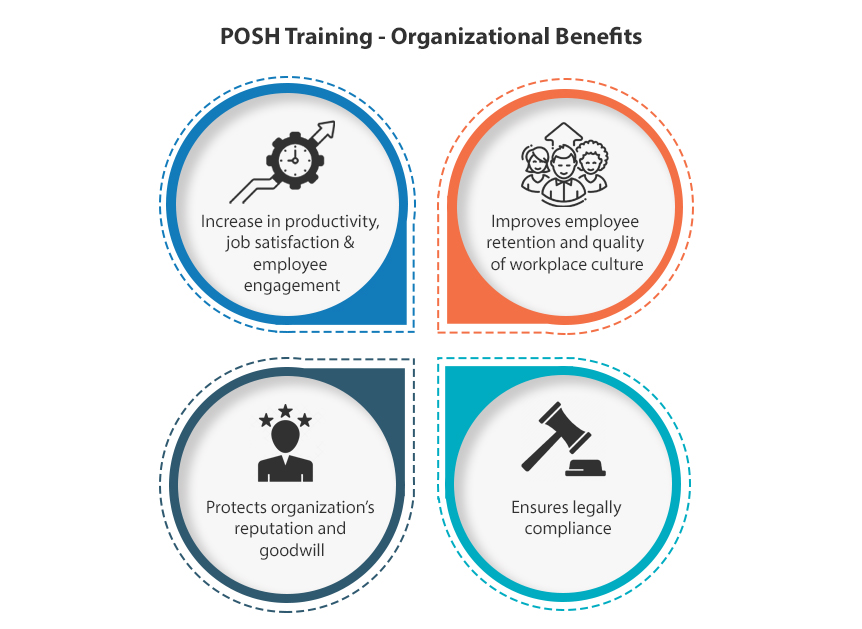
If you think the above mentioned are not good enough reasons to organize POSH training, here is a list of more benefits in conducting POSH training for the organization.
All employees in the organization – managers, directors, IC members, human resource professionals and employees- must go through the training. However, a one-size-fits-all training will not help. A common training on the law is important. In addition to this, there should role-specific training as well. For example, Internal Committee members (IC is the institution that will inquire into and redress sexual harassment complaints within the organization) must go through specific training on the inquiry procedure and redressal mechanism. Let us have a close look at what types of you should consider for your organization.
This course will cater to the entire workforce in the organization. Regardless of the gender or designation, every employee should have a clear understanding of the following:
A certain section of the employees has a team to manage and is obligated to provide a safe environment to their team members. They can be People Managers, Reporting Managers, Business Heads, Human Resources (Learning and Development) professionals, Diversity and Inclusion (D&I) champions, etc. The POSH training for them must enable them to effectively handle and manage sexual harassment incidents. Any inappropriate step or negligence on the part of the people manager will have severe consequences to the organization, team and the victim.
Ideally, the POSH training for managers should cover:
The POSH Act mandates that any organization with more than ten employees (including temporary contract employees or interns.) should constitute an Internal Committee which will have the power of a civil jury. They will inquire into POSH complaints and redress them.
It is important to train the IC members on the following:
As the Internal Committee plays a significant role in the organization’s mission of preventing sexual harassment at workplace, proper enablement of the Internal Committee is necessary.
eLeanPOSH’s Annual Subscription Program for IC Members is a great option for this. The IC members will be trained on their roles and responsibilities through the comprehensive eLearning module curated for the IC members. Triannual POSH Webinars conducted by industry experts with open Q&A will ensure that the IC Members are updated about the nuances of inquiry proceedings. IC Members will also get a chance to get their questions answered from the presenters.
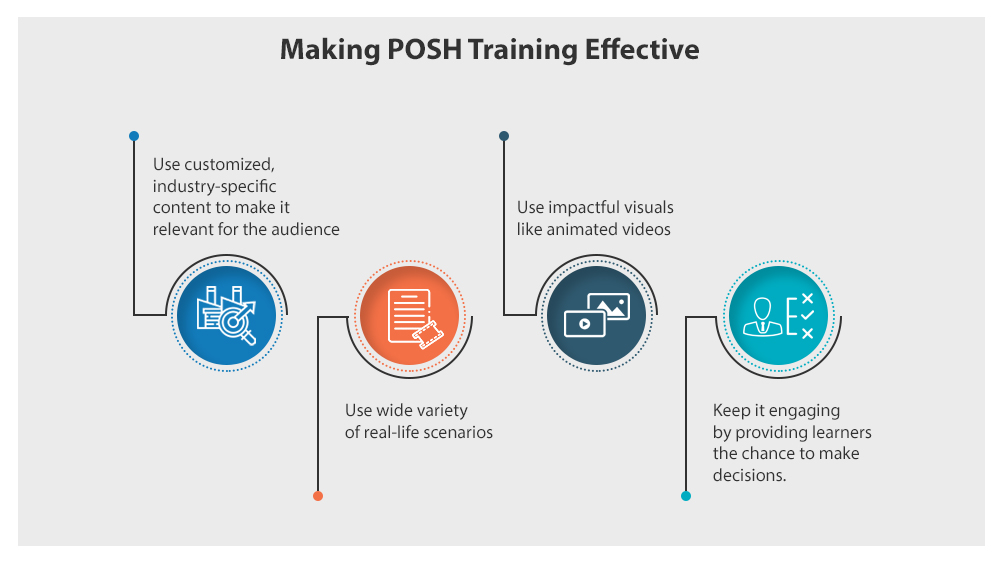
We have seen that there are several topics to be covered in each type of training. This can make the training long and boring. Here are a few tips to ensure that the learners stay engaged through out.
Many organizations contemplate on what mode of training they can use for POSH awareness. Should you go for POSH classroom training / workshop or POSH online / CBT modules? It mostly depends on the organization’s discretion because both eLearning and classroom training have their own pros and cons. However here are a few things you can consider while choosing the right mode of training.
Does your organization have employees working from different geographical locations?
Does your organization have a huge intake of employees every year?
Do you have employees who are not fluent in English?
Do you have the need to conduct training in multiple batches in a year because of the number of employees?
Are you worried that a trainer-led classroom training may not be effective for learners who have different learning styles like visual, auditory and kinesthetic?
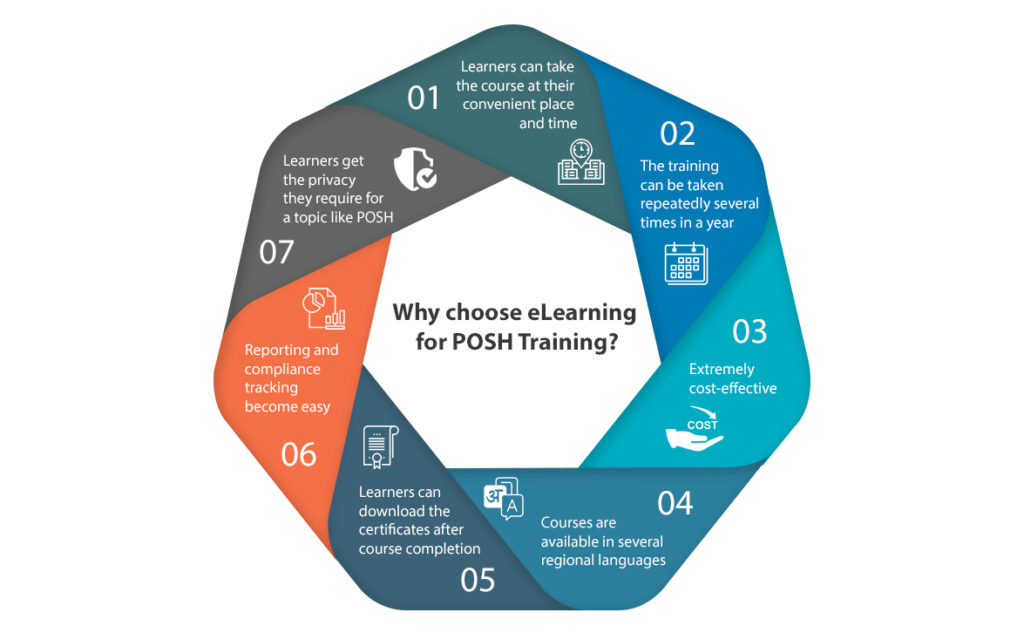
If your answer to most of these questions is yes, it is better for you to choose eLearning or online mode of POSH training. Here is why.
When you have employees who are geographically dispersed, it is easier for them to take the course at a pace and schedule of their convenience. Organization does not have to worry about organizing the training on a date and time when everyone is available.
Extensive use of activities, quizzes and rich animations combined with voice overs in eLearning mode of learning ensures that all learning objectives are met for all types of learners.
If you have a huge intake of employees every year, you can train the employees right away without waiting to get an optimal number of people to sit in the training room. When your organization has a huge employee size, the classroom training must be conducted in several batches and thus making you pay the trainer for each batch separately.
On the other hand, POSH online training can prove extremely economical because a course that is bought once can be reused several times. Another advantage of eLearning course is that the learner can choose to take the course in the language they are comfortable with, making it easier to cater to learners from different regional backgrounds.
Click here to check our video on POSH Awareness
Some other advantages of having eLearning courses are:
To conclude, for something like POSH training, which is not just a skill development initiative, but a legal mandate and necessity, it is better to choose an eLearning mode. While the direct beneficiary of POSH training is women employees, this training can yield positive results for the entire workforce and the organization.
Introduction: The Dangerous Misreading of Ordinary Warmth The Core Mistake: Confusing Social Access With Sexual Consent What the POSH Law Actually Looks…

1. Why synthetic sexual content belongs in the POSH conversation 2. Weather workplace have moved beyond office premises? How does this affects…
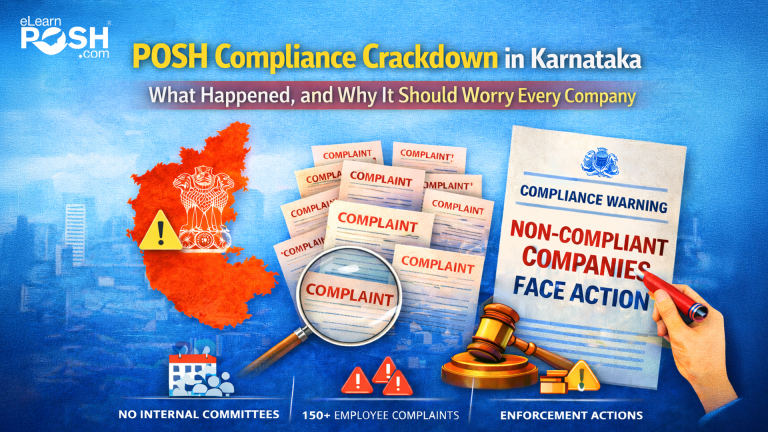
1. What Triggered the Karnataka POSH Crackdown? 2. The Legal Position Was Always Clear 3. The Gap Between Compliance and Functioning…
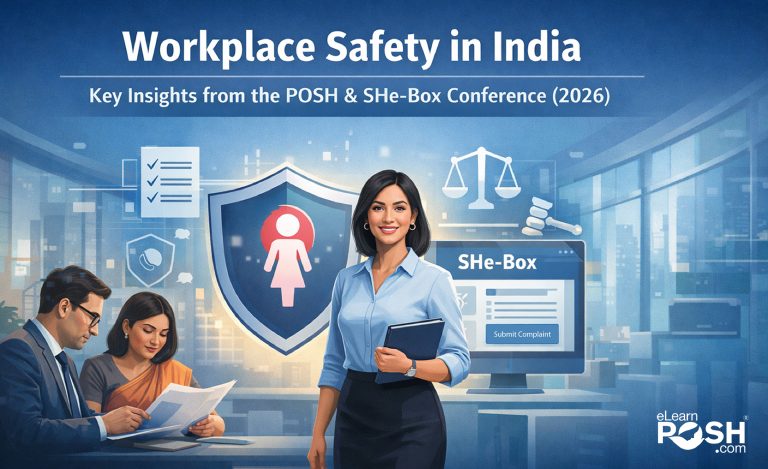
1. The Shift from POSH Compliance to Real Workplace Effectiveness 2. How SHe-Box Is Changing Workplace Harassment Reporting in India 3. Understanding…
Leave a Reply