


The “She Was Friendly” Fallacy: Why Warmth Is Not Consent
Introduction: The Dangerous Misreading of Ordinary Warmth The Core Mistake: Confusing Social Access With Sexual Consent What the POSH Law Actually Looks…

eLearnPOSH
Best training on POSH

The Sexual Harassment of Women at Workplace (Prevention, Prohibition and Redressal) Act, 2013, lays down a few steps that every workplace must follow to ensure that the employees are safe from harassment. When the term ‘workplace’ is used, one will think about corporates mostly.
Before we conclude that the Act is applicable to only corporates and government office, let’s take a look at the definition of workplace once again. Here is a part of the definition:
From the definition, it is clear that all educational institutions must also comply to the POSH Act.
Read Being POSH Compliant — Here’s What You Should Know! to know the steps for being POSH Compliant.
In addition to the POSH Act, the University Grant Commission also published a notification titled University Grants Commission (Prevention, prohibition and redressal of sexual harassment of women employees and students in higher educational institutions) Regulations, 2015 which mandates all universities, colleges and deemed to be universities to follow a set of guidelines to ensure that the campuses are free of sexual harassment.
This blog will list out the steps every Higher Educational Institution (HEI) must take to ensure compliance and the penalties for non-compliance according to the UGC Regulations.
Every Higher Educational Institution must publicly commit itself to a zero-tolerance policy towards sexual harassment, discrimination, harassment, retaliation and sexual assault at all levels. The Higher Educational Institution must also take proactive steps to stop all gender-based violence perpetrated against staff and students.
As per the POSH Act, the institution will already have a POSH Policy. The UGC regulations recommend the institutions to edit the policy, if needed, to include the definitions mentioned in the Regulations and modify the policy according to the Regulations. Authorities of Higher Educational Institutions must also ensure that the policy is made accessible to all staff and students.
Treat sexual harassment as a misconduct under service rules if the perpetrator is an employee and as a violation of the disciplinary rules if the perpetrator is a student.
Every Higher Educational Institution must constitute a team to redress sexual harassment complaints and name it Internal Complaints Committee (ICC), following the UGC guidelines. In case the institutions already has a committee functioning with the same objective, its name should be changed to Internal Complaints Committee. ICC will accept complaints from all the students and staff regardless of the gender and redress them according to the timeline prescribed by the regulations.
Higher Educational Institutions must take necessary steps to ensure that every person who visits the institution – staff and students and potential employees and students – are made aware of the following:
This can be done through posters in conspicuous places in the campus, printing in the prospectus and publishing in the college website.
Regular training or workshop must be conducted to all staff and students according to the guidelines indicated in the SAKSHAM Report (Measures for Ensuring the Safety of Women and Programmes for Gender Sensitization on Campuses). The training should include the important provisions of the Act and UGC Regulations and the duties and responsibilities of all staff and students to ensure safety within the institution. The procedure to file a complaint should also be covered in the training. It is ideal to conduct the training at least three times in a year.
Check out our comprehensive and interactive eLearning on Prevention of Sexual Harassment in Higher Educational Institution.
In addition, Higher Educational Institutions should give regular training to ICC on their role and responsibilities in preventing and redressing sexual harassment at workplace. This will empower them to accept and settle complaints of sexual harassment with utmost sensitivity.
Once the ICC completes its inquiry into a sexual harassment complaint, it should prepare a report with its findings and recommendations. This inquiry report will be shared with the Executive Authority of the Higher Educational Institution, the complainant and witnesses within 10 days. The Executive Authority must monitor the timely submission of this report.
The Executive Authority should also file an annual report every calendar year with details on the number of cases filed and their disposal to the UGC.
As you may already know, failing to comply to the provisions of the POSH Act can attract a penalty of fifty thousand rupees and cancellation of business license for repeated offence. But these penalties are not applicable to Higher Educational Institutions.
It is the University Grants Commission who will penalize higher educational institutions for non-compliance. Upon failure to comply to any provisions of the regulations, University Grants Commission will notify the institution about the same and give them an opportunity to explain their side. If the UGC is not satisfied with the explanation of the institution, Commission will take one or more of the following actions against the institution:
Educational institutions must provide an environment that encourages learning and development to the students as well as the staff. It is important that the higher educational institutions are safe from acts like harassment, discrimination or ragging to ensure such an environment for all students. Hence complying to the Regulations is not only a legal mandate but also a from the ethical standpoint.
Get answers and FREE consultations for all your POSH related queries. Click here to Join our ‘Not-for-profit’ LinkedIn group.
Introduction: The Dangerous Misreading of Ordinary Warmth The Core Mistake: Confusing Social Access With Sexual Consent What the POSH Law Actually Looks…

1. Why synthetic sexual content belongs in the POSH conversation 2. Weather workplace have moved beyond office premises? How does this affects…
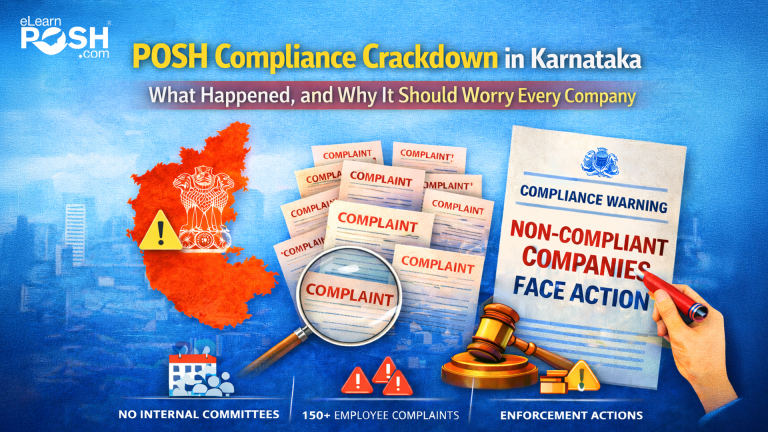
1. What Triggered the Karnataka POSH Crackdown? 2. The Legal Position Was Always Clear 3. The Gap Between Compliance and Functioning…

1. The Shift from POSH Compliance to Real Workplace Effectiveness 2. How SHe-Box Is Changing Workplace Harassment Reporting in India 3. Understanding…
Leave a Reply