• Skip to primary navigation
  • Skip to main content
eLearnPOSH

eLearnPOSH

Best training on POSH

  • POSH Courses

    • POSH Training for Employees
    • POSH Training for Managers
    • POSH Training for IC Members
    • POSH Training for Higher Educational Institutions
    • POCSO - Prevention of Child Sexual Abuse

    Global Courses

    • Unconscious Bias
    • Equality, Diversity & Inclusion
    • Sexual Harassment Prevention for US

    Important Resources

    • SHe-Box
    • Compliance Management System
    • About Us
    • FAQ
  • POSH Act
  • External Members Directory
  • Our Webinars
  • Resources

    • Blog
    • Newsletter
    • Media
    • Enterprise Features
sales@succeedtech.com
+91 97405 76761
Contact Us
Home > Blog > Third Party Harassment under POSH: Which IC Has Jurisdiction ?

Third Party Harassment under POSH: Which IC Has Jurisdiction ?

December 19, 2025 by Depakar B Leave a Comment

Third Party Harassment under POSH: Which IC Has Jurisdiction ? 1

1. Supreme Court clarifies IC Jurisdiction

2. Key Interpretations by the Court

3. Reasoning Underlying the Decision

4. Implications for Private Workplaces


Supreme Court clarifies IC Jurisdiction 

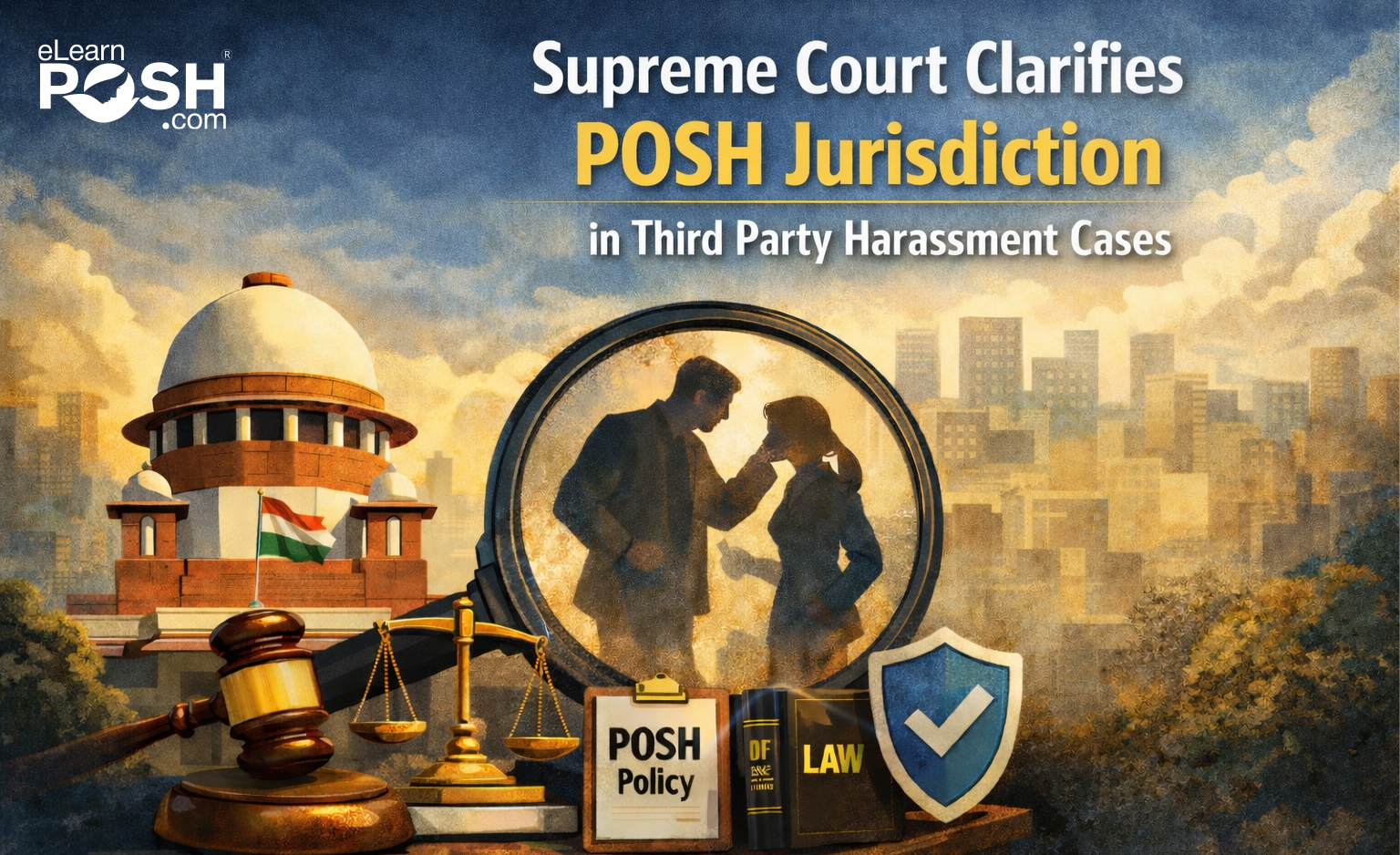
With the recent Supreme Court decision in the case of Dr. Sohail Malik Vs Union of India, the understanding of jurisdiction of the Internal Committee under the POSH Act has undergone a significant shift. While, from the provisions of the POSH Act, it was understood that a complaint is maintainable even when the respondent is a third party, the procedure to be followed in such cases was not clearly established under the Act. 

The Supreme Court has now settled this issue. It has held that an aggrieved woman is entitled to file her complaint before the Internal Committee of her own workplace. The Court has also clarified that this Internal Committee has the authority to conduct the inquiry and issue its findings and recommendations, even when the respondent belongs to another organisation or department. 

That said, the position is not as simple as it may appear. While the Court has taken a purposive approach to interpreting Section 11 and expanded the inquiry jurisdiction of the Internal Committee, several structural and procedural gaps under the POSH framework still remain. These gaps are particularly evident in private sector workplaces, where coordination between organisations, enforcement of recommendations, and accountability of third-party respondents are not clearly addressed under the Act. 

Key Interpretations by the Court 

  • The POSH Act does not require the respondent to be an employee of the same workplace as the aggrieved woman. Any person against whom a complaint is filed can be treated as a respondent under the Act. 
  • Section 11 of the POSH Act only explains the procedure for conducting an inquiry. The phrase “where the respondent is an employee” does not limit the jurisdiction of the Internal Committee to the respondent’s workplace. 
  • The Court clarified that the word “where” in Section 11 means “if” or “in case” and is used only to explain the procedure to be followed when the respondent is an employee, not to decide which Internal Committee has jurisdiction. 
  • A narrow interpretation that forces an aggrieved woman to approach the Internal Committee of the respondent’s workplace would defeat the object of the POSH Act and create practical barriers to justice. 
  • The definition of “workplace” under the POSH Act is broad and includes any place visited during the course of employment. This allows the Internal Committee of the aggrieved woman’s workplace to take up the complaint even if the respondent belongs to another organisation. 
  • The Internal Committee at the aggrieved woman’s workplace is empowered to conduct the inquiry and record findings and recommendations, even in cases involving third party respondents. 
  • The power to conduct the inquiry is separate from the power to take disciplinary action. Where the respondent is employed elsewhere, the employer of the respondent is responsible for acting on the Internal Committee’s recommendation. 
  • Requiring complainants to approach the respondent’s Internal Committee in third party cases would discourage reporting and weaken the protection intended under the POSH Act. 

Reasoning Underlying the Decision 

  • Applicability of Service Rules 

In this case, both the aggrieved woman and the respondent were government employees governed by service rules. Where service rules apply, a two-step inquiry process is followed, and the Internal Committee performs a dual role. 

  • First Stage Role of the Internal Committee 

Upon receipt of the complaint, the IC acts as a fact-finding authority and conducts an inquiry into the allegations. After completing this inquiry, the IC submits its report and recommendations to the Disciplinary Authority or employer of the respondent, who may then initiate formal disciplinary proceedings by issuing notice and framing a chargesheet. 

  • Second Stage Role of the Internal Committee 

At the second stage, the IC functions as the inquiring authority and conducts the formal inquiry in accordance with the applicable service rules, such as the CCS CCA Rules in the case of government employees. 

  • Court’s Conclusion on Jurisdiction and Roles 

On this basis, the Court observed that the IC at the aggrieved woman’s workplace is competent to conduct the inquiry and make recommendations as a fact-finding authority, while the IC at the respondent’s workplace can act as the inquiring authority and proceed with disciplinary action to determine whether and how those recommendations are to be implemented. 

Implications for Private Workplaces 

If the same reasoning is extended to private sector workplaces, the IC at the aggrieved woman’s workplace will act like a fact finding authority and would conduct the inquiry and send its findings and recommendations to the respondent’s employer. The IC at the respondent’s workplace would then act as the inquiring authority and carry out disciplinary proceedings against the respondent. 

While this approach allows the complainant to file the complaint at her own workplace, she may still be required to participate in disciplinary proceedings conducted by the IC at the respondent’s workplace. This creates practical and logistical difficulties for the complainant and, negates the objective of allowing her to file complaint at a place of her convenience. This also leads to multiple proceedings from a single complaint, increasing procedural complexity. 

In the absence of a clear statutory framework, there is no uniform mechanism governing how the findings and recommendations of one Internal Committee are to be treated by another. As a result, the IC at the respondent’s workplace may not necessarily accept or act upon the findings of the IC at the aggrieved woman’s workplace, owing to differences in inquiry approach, assessment of evidence, procedural expectations, or organisational priorities and interests. This lack of clarity further compounds procedural uncertainty and inconsistency in outcomes.

For the foregoing reasons, eLearnPOSH is of the view that while the aggrieved woman may file a complaint before the Internal Committee of her own workplace, the inquiry should ideally be conducted by the Internal Committee at the respondent’s workplace. The Internal Committee at the aggrieved woman’s workplace can play a supportive role by identifying and coordinating with the respondent’s Internal Committee, forwarding the complaint, and extending any assistance required to the complainant during the inquiry process.

Share:
Share on:

Disclaimer: The content provided on elearnposh.com website like data, judgments, and opinions are only for informational / educational purposes in a general context. The content do not constitute legal advice and are not a substitute for legal advice for a specific case where the facts of the case are not known. You should seek legal advice or other professional advice in relation to any particular matters you or your organisation may have.

Filed Under: POSH Act, POSH Compliance Tagged With: POSH, posh act

Reader Interactions

Leave a Reply Cancel reply

Your email address will not be published. Required fields are marked *

Contact Details

  • 📧 sales@succeedtech.com
  • 📱 +91-70190 12446
  • 📱 +91-97405 76761
  • 📱 +91-86604 48654
ISO 27001 Information Security Management System Certified GDPR Compliant AICPA SOC for Service Organizations

Solutions

  • POSH Courses
  • POSH Training for Employees
  • POSH Training for Managers
  • POSH Training for IC Members
  • POSH Training for Higher Educational Institutions
  • POCSO - Prevention of Child Sexual Abuse
  • Global Courses
  • Unconscious Bias
  • Equality, Diversity & Inclusion
  • Sexual Harassment Prevention for US

Get Social With Us

Ariba Network

Subscribe to our newsletter

Copyright © 2024 eLearnPOSH.com Powered By Succeed Technologies®

  • Terms and Conditions
  • Privacy Policy
  • FAQs
  • Sitemap
This website uses cookies to improve your experience.
ACCEPT Privacy Policy
Privacy & Cookies Policy

Privacy Overview

This website uses cookies to improve your experience while you navigate through the website. Out of these cookies, the cookies that are categorized as necessary are stored on your browser as they are essential for the working of basic functionalities of the website. We also use third-party cookies that help us analyze and understand how you use this website. These cookies will be stored in your browser only with your consent. You also have the option to opt-out of these cookies. But opting out of some of these cookies may have an effect on your browsing experience.
Necessary
Always Enabled
Necessary cookies are absolutely essential for the website to function properly. This category only includes cookies that ensures basic functionalities and security features of the website. These cookies do not store any personal information.
Functional
Functional cookies help to perform certain functionalities like sharing the content of the website on social media platforms, collect feedbacks, and other third-party features.
Performance
Performance cookies are used to understand and analyze the key performance indexes of the website which helps in delivering a better user experience for the visitors.
Analytics
Analytical cookies are used to understand how visitors interact with the website. These cookies help provide information on metrics the number of visitors, bounce rate, traffic source, etc.
Advertisement
Advertisement cookies are used to provide visitors with relevant ads and marketing campaigns. These cookies track visitors across websites and collect information to provide customized ads.
Others
Other uncategorized cookies are those that are being analyzed and have not been classified into a category as yet.
SAVE & ACCEPT