


The “She Was Friendly” Fallacy: Why Warmth Is Not Consent
Introduction: The Dangerous Misreading of Ordinary Warmth The Core Mistake: Confusing Social Access With Sexual Consent What the POSH Law Actually Looks…

eLearnPOSH
Best training on POSH
1. First Principle: A POSH Complaint Is an Allegation, Not a Verdict
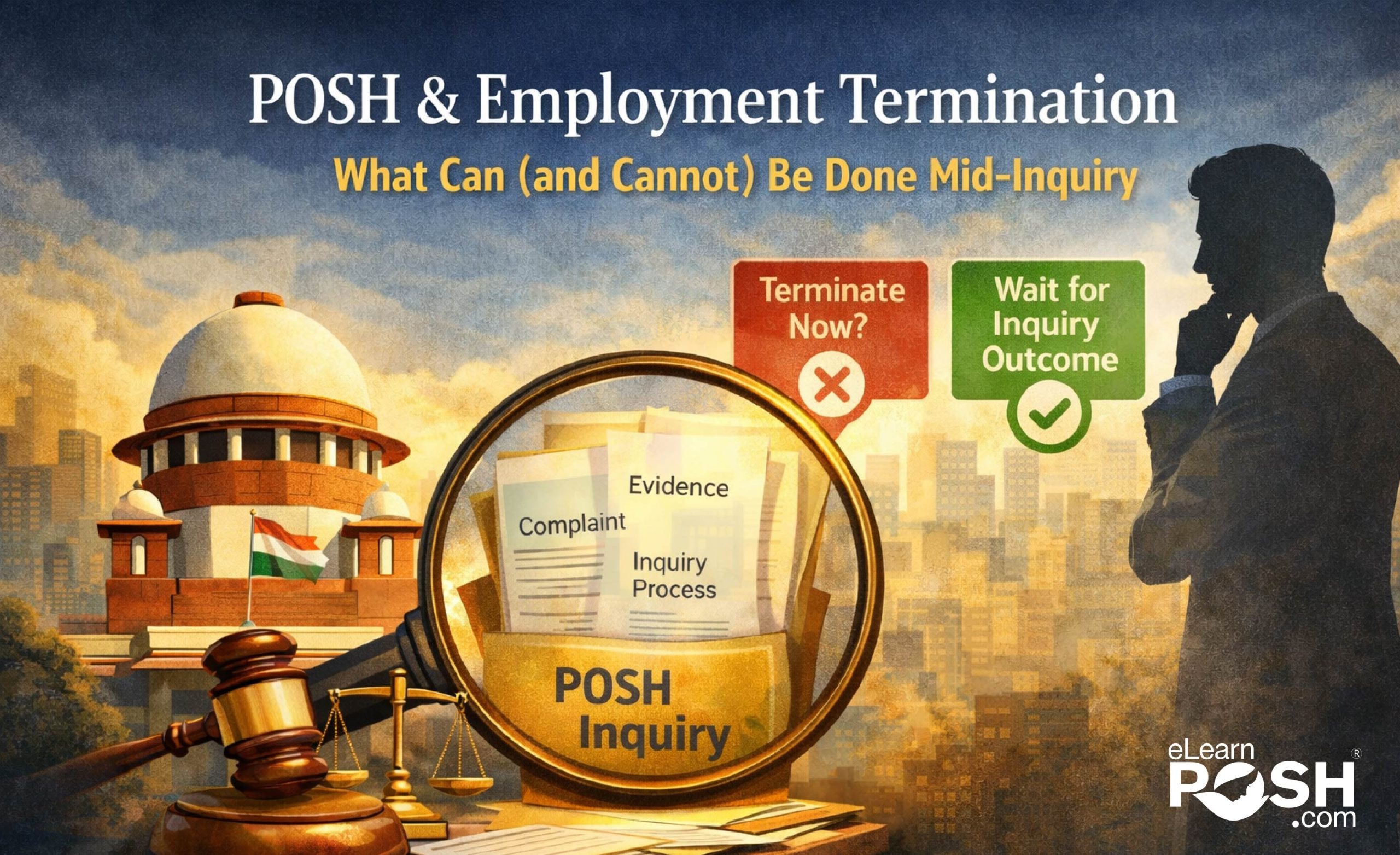
2. Can an Employee be Terminated Mid-Inquiry?
3. What if the Employee Resigns During the Inquiry?
4. What the Law Explicitly Does NOT Allow
5. What Employers CAN Do Mid-Inquiry (And Should Do Carefully)
6. What Happens If an Employee Does Not Participate in a POSH Inquiry?
7. Why “We’ll Decide Later” Is Not a Weak Response
A POSH complaint rarely arrives quietly. It usually comes with urgency, anxiety, internal pressure, and a hundred whispered questions one of the biggest being: “Can we just terminate this employee and be done with it?” or “What is the employee resigns mid investigation?”
For HRs and managers, this moment is a legal landmine. Act too slowly and you’re accused of inaction. Act too fast, and you may end up violating the very law you’re trying to comply with. Termination during a pending POSH inquiry sits exactly at this crossroads and Indian courts have made it clear that intentions don’t excuse procedural mistakes.
This blog unpacks what the law actually permits, what it clearly prohibits, and where organizations most often get it wrong.
One of the foundational principles under the POSH Act, 2013 is simple: disciplinary consequences can follow only after a proper inquiry is completed. The moment an employer begins treating a complaint as though it is already proven, the process becomes legally vulnerable.
Once a written complaint is received, the Internal Committee is required to conduct an inquiry in accordance with principles of natural justice. This means issuing notice, giving an opportunity to respond, examining evidence from both sides, and arriving at a reasoned conclusion. Until the final report is issued, there is no legal basis for punishment. In employment law, termination is the most serious form of disciplinary action and cannot precede findings.
The inquiry is not a mere procedural formality it is central to compliance and protects the organisation from legal challenge.

Termination during a pending POSH inquiry is not automatically prohibited. However, it cannot be because of the complaint itself. The reason for termination must be entirely independent of the POSH allegations and must be supported by proper documentation.
More importantly, termination can occur only if such action is permitted under the organisation’s service rules, employment contract, or standing orders. POSH does not create new disciplinary powers. It provides a mechanism for inquiry and recommendations, but the actual disciplinary action must fall within the framework of existing service conditions.
For example, if a fixed-term contract is naturally expiring, if a company-wide redundancy was already in motion, or if there is unrelated misconduct supported by prior records, termination may proceed provided the organisation has the authority under its service rules to do so. However, if termination closely follows the filing of a complaint and appears connected to it, courts are likely to examine the timing carefully. The employer must be able to demonstrate that the decision was independent, rule-backed, and not retaliatory.
Resignation does not automatically bring the inquiry to an end. The purpose of the Internal Committee is fact-finding and institutional accountability. The process is not limited to determining whether someone continues in employment.
If an employee resigns mid-inquiry, the Committee is generally expected to complete the proceedings and record its findings. Closing the matter simply because employment has ended can create compliance gaps and may later be questioned. Completing the inquiry ensures procedural integrity and protects the organisation from allegations that accountability was avoided.
Terminating an employee accused in a POSH complaint simply to “send a strong message” or to protect organisational reputation before the inquiry is completed is unlawful. Reputation management can never override statutory due process. The law requires organisations to follow the inquiry process first, and act only after findings are established.
Similarly, taking action against the complainant even indirectly is treated very seriously. This includes actions such as non-renewal of contracts, role removal, forced resignation, or any decision that appears linked to the complaint being filed. Courts often view such actions as victimisation and have, in several cases, ordered reinstatement or compensation.
Another common mistake is using performance concerns, policy violations, or “loss of trust” as justification when these issues suddenly appear only after a POSH complaint is filed. If the concern was genuine, there should be documented evidence showing that it existed before the complaint. If not, it may be viewed as a post-complaint justification rather than a genuine employment concern.
A POSH inquiry does not mean an organisation has to pause all decision-making or workplace functioning. The law recognises operational realities but it expects employers to act carefully, neutrally, and in a way that protects the integrity of the inquiry.
 One of the most important things employers can do mid-inquiry is ensure the process moves efficiently and fairly. This includes issuing timely notices, scheduling hearings without unnecessary delay, ensuring both parties are heard, and maintaining proper records of proceedings. Delays or procedural gaps often become grounds for legal challenge later.
Employers are also permitted to implement interim workplace measures where required. These measures must be protective, not punitive. For example, temporary reporting changes, seating or team changes, remote work arrangements, or temporary leave can be considered if required to prevent workplace tension, witness influence, or uncomfortable interactions. The key is to ensure these steps are documented as process safeguards not as punishment or conclusions.
In certain situations, employers may place an employee under suspension during the inquiry. This is generally viewed as permissible when it is necessary to protect evidence, prevent interference with witnesses, or maintain workplace safety. However, suspension must be temporary, reasoned, and clearly linked to process integrity not reputational concerns or assumptions of guilt. Furthermore, a suspension can happen only if it is mentioned in the service rules of the organisation.
Employers can also continue normal business decisions that were already in motion before the POSH complaint, such as restructuring, project closure, or fixed-term contract expiry provided there is clear documentation showing that the decision is independent of the complaint. In such cases, documentation and timing become critical.
Another important responsibility employers have mid-inquiry is maintaining confidentiality. Organisations must ensure that details of the complaint, evidence, and proceedings are shared only on a need-to-know basis. Internal gossip, informal disclosures, or careless communication can create additional legal risk.
If an employee does not participate despite proper notice and reasonable opportunity, employers can allow the ICC to proceed with the inquiry based on available evidence. However, employers must ensure there is clear proof that fair opportunity was given.
Employers must also be prepared to implement the IC’s interim recommendations where legally valid and operationally feasible. Ignoring IC recommendations without valid reason can weaken the organisation’s compliance position.
Perhaps most importantly, employers must maintain neutrality in communication and conduct. Internal emails, meeting discussions, and HR communication should avoid language that suggests assumptions of guilt or dismissal of the complaint. In many cases, internal communication records later become part of legal scrutiny.
Employers should also be aware that an inquiry does not have to stop if an employee chooses not to participate. Where an employee repeatedly fails to attend hearings or respond to notices despite being given proper notice and reasonable opportunity, the IC is permitted to proceed ex parte.
 However, ex parte proceedings cannot be initiated casually or at the first instance of non-attendance. The IC is expected to demonstrate that reasonable and documented efforts were made to secure participation. This typically includes issuing written notices of hearing dates, providing sufficient response time, sharing relevant documents where required, and clearly communicating that continued non-participation may result in the inquiry proceeding in the employee’s absence.
Even when an inquiry proceeds ex parte, the IC is still bound by the principles of natural justice. The committee must independently evaluate available evidence and record reasoned findings. Ex parte does not automatically mean an adverse conclusion. Courts generally uphold ex parte findings only where it is clear that procedural fairness was genuinely provided but not utilised by the employee.
Copies of notices, email delivery records, meeting invitations, acknowledgement trails, and follow-up communication often become key evidence if the inquiry findings are later challenged. In many cases, courts focus less on whether ex parte was used, and more on whether the opportunity to participate was real, reasonable, and well-documented.
Employers should also avoid rushing into ex parte proceedings. Allowing reasonable adjournments, permitting written submissions, or offering virtual participation options can demonstrate procedural fairness and strengthen the defensibility of the inquiry if questioned later.
Many managers worry that waiting for the inquiry outcome may make the organisation appear slow or indecisive. Legally, the reality is quite the opposite. Courts expect employers to exercise restraint while an inquiry is ongoing. Taking action only after the IC submits its findings reflects adherence to statutory due process and strengthens the organisation’s legal position.
Once the inquiry report is received, the employer’s role becomes clearer. If the allegations are substantiated, disciplinary action including termination may be taken strictly in accordance with applicable service rules and organisational policies. If the allegations are not substantiated, the employee against whom the complaint was made must be protected from any adverse or retaliatory consequences. Where a complaint is found to be malicious, action against the complainant may be considered, but only where there is clear evidence of deliberate false implication.
It is when organisations bypass this sequence acting before findings are recorded or beyond what service rules permit that legal exposure typically arises.
Ultimately, the greatest risk in a POSH matter rarely lies in the complaint itself, but in how the organisation responds to it. The law does not demand inaction it demands disciplined action. Acting within the framework of the inquiry process and within the limits of established service rules is what protects institutional credibility. In POSH compliance, restraint is not weakness. It is governance backed by law.
Introduction: The Dangerous Misreading of Ordinary Warmth The Core Mistake: Confusing Social Access With Sexual Consent What the POSH Law Actually Looks…

1. Why synthetic sexual content belongs in the POSH conversation 2. Weather workplace have moved beyond office premises? How does this affects…
1. What Triggered the Karnataka POSH Crackdown? 2. The Legal Position Was Always Clear 3. The Gap Between Compliance and Functioning…

1. The Shift from POSH Compliance to Real Workplace Effectiveness 2. How SHe-Box Is Changing Workplace Harassment Reporting in India 3. Understanding…
Leave a Reply