


The “She Was Friendly” Fallacy: Why Warmth Is Not Consent
Introduction: The Dangerous Misreading of Ordinary Warmth The Core Mistake: Confusing Social Access With Sexual Consent What the POSH Law Actually Looks…

eLearnPOSH
Best training on POSH

I) Receiving complaints: extending timeline
II) Power to Assess Whether Allegations Constitute Sexual Harassment
III) Obligation to facilitate Conciliation
IV) Power equivalent to Civil Court
V) Examining Evidence and Cross -examination
VI) Power to recommend Interim Reliefs
While courts and police authorities already existed, the Sexual Harassment of Women at Workplace (Prevention, Prohibition and Redressal) Act, 2013 (POSH Act) introduced the Internal Committee (IC), recognizing that relying only on external channels often made reporting sexual harassment at workplaces difficult and time consuming.
Section 4 of the Act mandates that every workplace with ten or more employees must constitute an IC, which serves as the designated body to receive and address complaints of workplace sexual harassment. Vested with powers similar to those of a Civil Court, the IC functions as an internal, quasi-judicial authority that makes the process more accessible, confidential, and workplace sensitive.
However, these civil court, like powers are limited. They extend only to summoning and ensuring the attendance of witnesses, examining them on oath, and directing the discovery and production of relevant documents for the purpose of inquiry. Beyond this, the IC’s contribution lies in promoting awareness, guiding preventive measures, and supporting the organisation in building a safe and respectful workplace culture.
This blog post explores the extensive powers vested in the IC and examines how these powers have been applied and interpreted through relevant case laws.
Note: The role of the Internal Committee (IC) and the nature of its recommendations may vary depending on the organisation’s policy and code of conduct. In the case of government organisations, inquiries are generally governed by applicable service rules. Please consult a qualified legal professional for specific guidance.
The Internal Committee (IC) is the designated authority under Section 9 of the POSH Act to receive complaints of workplace sexual harassment. Any woman employee, or even a visitor such as a client, vendor, or intern, may submit a written complaint to the IC within three months from the date of the alleged last incident. If the complainant is unable to prepare the complaint on her own, the IC is expected to provide reasonable assistance.
What makes this provision significant is that the IC has the discretion to extend the filing timeline by an additional 3 (three) months. In such cases, the IC must consider the reasons for delay and decide whether they are acceptable. This discretion is critical, because the IC’s decision on limitation determines whether or not the inquiry can proceed.
Sometimes the date of the “last incident” may itself be in dispute. In such situations, the IC may examine oral testimony and documentary evidence to decide if the complaint has been filed within the permitted time.
The Delhi High Court in Shital Prasad Sharma v. State of Rajasthan and Ors. the IC could extend the time limit for filing a complaint by another 3 months, i.e. up to six months from the date the incident has taken place, by recording reasons in writing, if it is satisfied that circumstances prevented the complainant filing of complaint earlier.
In the case of S.Ravi Selvan vs Central Board Of Indirect Taxes & Customs the Madras High Court held that “under Section 9 of the POSH Act, the IC alone has the discretion to extend the complaint timeline by three months, and such questions must be decided based on oral and documentary evidence”.
In Mohammad Altaf Bhat vs Principal Chief of Commissioner and Ors, the High Court of Jammu & Kashmir and Ladakh held that any complaint filed beyond this six-month limit is not maintainable, and the Internal Committee has no jurisdiction to inquire into it.
Before proceeding with an inquiry, the IC has the duty to first determine whether the allegations in the complaint actually amount to “sexual harassment” as defined under Section 2(n) of the POSH Act. This is a threshold assessment.
If the allegations clearly do not fall within the scope of sexual harassment, for example, if they relate to interpersonal conflicts, performance issues, or other workplace grievances, the IC does not have the power to proceed with an inquiry under the Act. Even gender discrimination with sexual connotation cannot be considered as Sexual Harassment. In such cases, the IC should record its reasons and, where appropriate, guide the complainant to the proper forum or authority.
The Supreme Court in P.N. Bhatia v. The Director General, National Academy of Customs, Indirect Taxes and Narcotics, where it was held that for an act to constitute sexual harassment under the Act, it must have a sexual advance or behaviour, and a complaint that lacks any sexual connotation would not be maintainable.
In X vs. The Kerala State Financial Enterprises Limited, the Hon’ble High Court of Kerala, reinforced this principle, holding that a complaint that does not allege sexual harassment cannot be proceeded with under the POSH Act.
Before starting a formal inquiry, the IC has the power under Section 10 of the POSH Act to facilitate conciliation between the complainant and the respondent, if the complainant herself requests it. Importantly, monetary settlement cannot be the basis of conciliation.
The IC’s role is not to pressure parties into compromise, but to provide a safe and voluntary space for amicable resolution. If a settlement is reached, the IC must record it, forward the report to the employer, and ensure that both parties comply with its terms. If conciliation fails, or if the complainant does not opt for it, the IC must move forward with a formal inquiry without delay.
In Dr. Kali Charna Sabat v. Union of India & Ors., the Madhya Pradesh High Court held that a conjoint reading of Sections 10 and 11 of the POSH Act makes it clear that the IC is under an obligation to attempt conciliation first, and only if it fails the matter be taken up for inquiry.
The IC has powers similar to those of a Civil Court under Section 11(3) of the Act for the purpose of conducting a formal inquiry into complaints of workplace sexual harassment, with. These powers include:
The IC has the power to examine the complainant, respondent, and witnesses under oath. This elevates the inquiry from a routine HR process to a quasi-judicial proceeding. Testimonies given under oath carry greater weight, and false statements can amount to misconduct or even perjury if pursued further.
Both parties must also be given the opportunity to cross examine each other’s witnesses or to put questions through the IC. However, when witnesses may feel threatened or unable to depose freely in the presence of the respondent/accused, the IC can permit cross examination through written questionnaires. This approach has been upheld by court in Prof. Bidyug Chakraborty v. Delhi University & Ors.
Further, in the case of Vimalkant Bhanuprasad Shrimali vs. IDMC Limited, the High Court of Gujarat said that in POSH cases, verbal cross-examination is not mandatory, a written cross- examination is acceptable.
In Medha Kotwal Lele and Others v. Union of India and Others, the Supreme Court held that the complaints committee shall be deemed to be the Inquiry Authority.
During the pendency of an inquiry, the IC may recommend interim measures to protect the aggrieved woman as per Section 12 of the Act. These include:
In Confidential v. Indian Institute of Corporate Affairs, the Delhi High Court confirmed that the petitioner has the right to approach IC for immediate protection that may be required and that the IC is empowered to grant interim relief, if it deems fit.
After completing its inquiry, the IC must submit a detailed report to the employer. Depending on the outcome, the IC may recommend appropriate action against the person found guilty of misconduct, whether it is the respondent (when allegations are proved) or the complainant (if the complaint is malicious or knowingly false). Such action must be taken in accordance with the service rules applicable to that individual or, where no such rules exist, under the organisation’s POSH Policy, Code of Conduct, or Disciplinary Policy.
Such powers must be exercised carefully. Recommendations should be based on the verbal and documentary evidence placed on record and must always be proportionate to the gravity of the offence established.
Along with these powers, the IC carries the greater responsibility of ensuring that every inquiry is conducted in line with the principles of natural justice. Rule 7 (4) of POSH Rules, 2013 provides that the Complaints Committee shall make inquiry into the complaint in accordance with the principles of natural justice. These principles are the foundation of a fair, impartial, and credible process. For the IC, this translates into:
For Internal Committee training and support, reach out to us at sales@succeedtech.com
Introduction: The Dangerous Misreading of Ordinary Warmth The Core Mistake: Confusing Social Access With Sexual Consent What the POSH Law Actually Looks…

1. Why synthetic sexual content belongs in the POSH conversation 2. Weather workplace have moved beyond office premises? How does this affects…
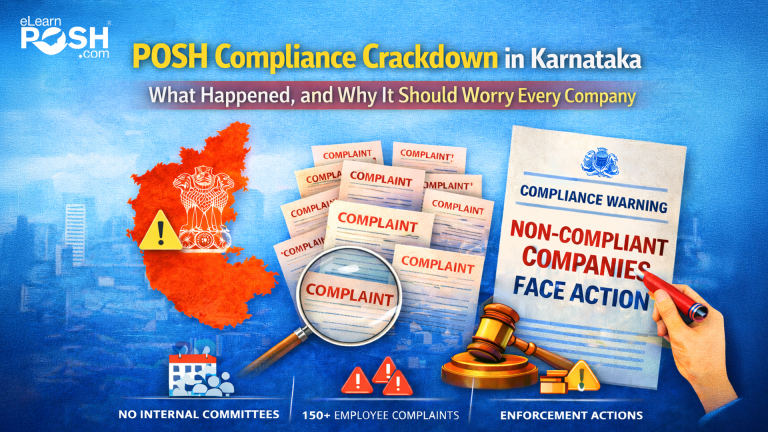
1. What Triggered the Karnataka POSH Crackdown? 2. The Legal Position Was Always Clear 3. The Gap Between Compliance and Functioning…

1. The Shift from POSH Compliance to Real Workplace Effectiveness 2. How SHe-Box Is Changing Workplace Harassment Reporting in India 3. Understanding…
Leave a Reply