


The “She Was Friendly” Fallacy: Why Warmth Is Not Consent
Introduction: The Dangerous Misreading of Ordinary Warmth The Core Mistake: Confusing Social Access With Sexual Consent What the POSH Law Actually Looks…

eLearnPOSH
Best training on POSH
2. What is the Karnataka Menstrual Leave Policy 2025?
3. To whom is the policy applicable?
5. Challenges in implementing the policy
6. Menstrual leave and compliance under DPDPA
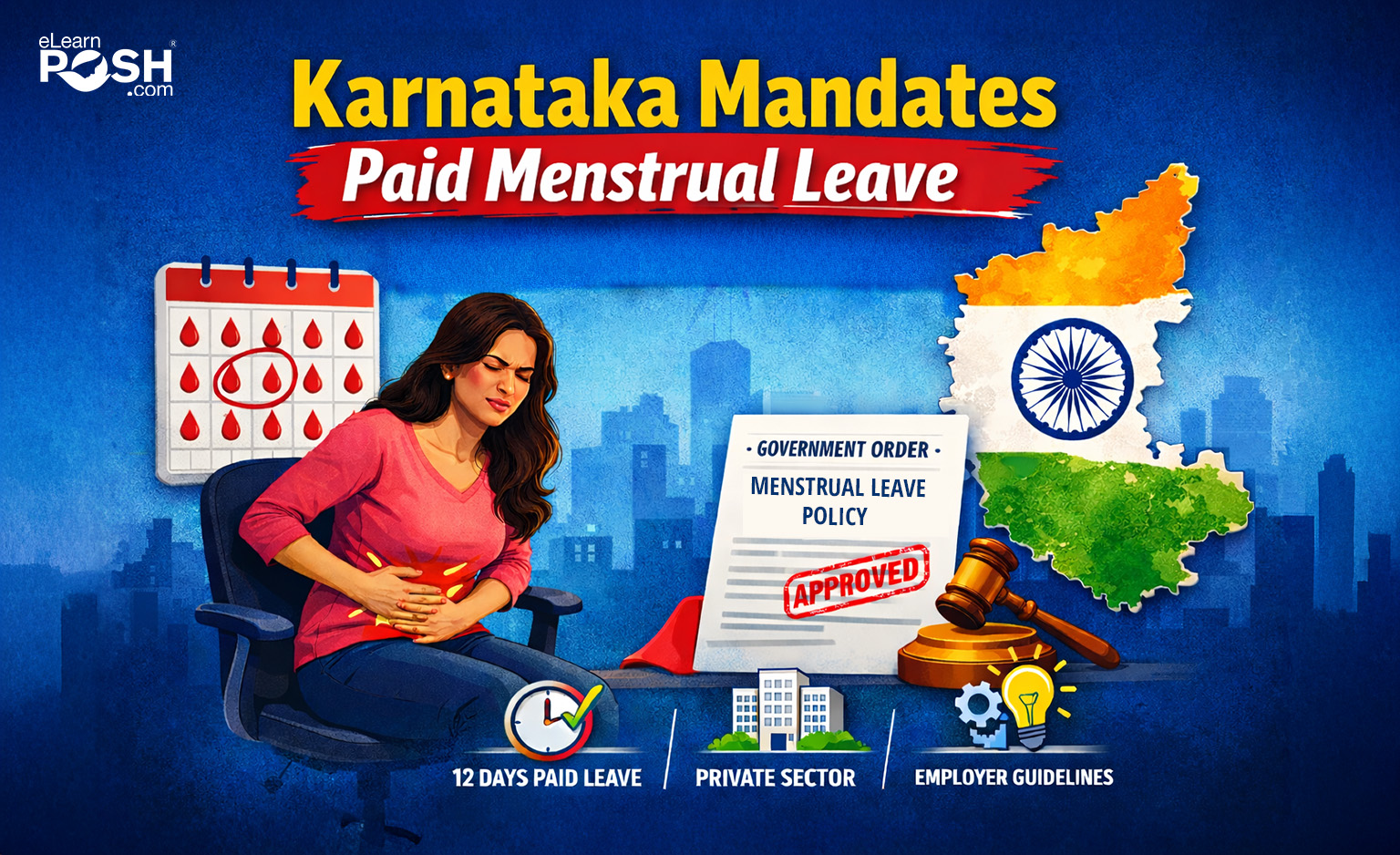
The Karnataka Government has taken a significant step by formally recognising menstrual health as a workplace issue rather than treating it as a purely personal concern. Through Government Order No. LD 466 LET 2023 dated November 20, 2025, the State has mandated twelve days of paid menstrual leave for women employees working in establishments registered under various labour statutes in Karnataka.
The operative portion of the Government Order makes it clear that the objective of this measure is to enhance the health, efficiency, mental well-being, and overall productivity of women employees.
Several states such as Bihar, Odisha, and Sikkim have for many years provided menstrual leave to women working in the government sector, while Kerala has extended similar support to students. Karnataka, however, has taken a distinct step by becoming the first Indian state to formally mandate paid menstrual leave for women employed in the private sector as well.
Although the validity of the Government Order is currently under challenge before the Karnataka High Court, the policy marks an important development in labour welfare regulation. This blog explains what the policy provides, who it applies to, and the key benefits and practical challenges that employers may encounter while implementing the mandate.
The Karnataka Menstrual Leave Policy 2025, notified in November 2025, treats menstrual health as a genuine workplace concern. The policy is meant to support women who experience discomfort such as cramps, fatigue, or migraines during menstruation, by allowing them to take leave without losing pay or using up their sick leave.
The policy has a wide scope and applies to women employees across different age groups and employment arrangements.
In effect, the policy covers a large section of women employees working in both private and government establishments across Karnataka.
Menstrual leave is not just about taking a day off. It reflects a broader shift in how workplaces view health, dignity, and inclusion.
Despite the positive intent, the policy faces several hurdles in the real world:
There is a valid concern that private employers might become hesitant to hire women to avoid the “cost” of 12 extra paid leaves, potentially worsening the gender gap in certain industries. In the year 2023, a Public Interest Litigation (PIL) (Shailendra Mani Tripathi v. Union of India) was filed before the Supreme Court, seeking a nationwide menstrual leave policy. However, the Court declined to issue directions, noting the complex policy implications, and directed the petitioner to make a representation to the Ministry of Women & Child Development while noting that menstrual leave might discourage employers from employing women.
There is also a risk of discrimination in hiring. With existing obligations on employers such as maternity benefits and creche facilities, mandatory cab facilities for late working women, employers – especially small establishments – may view menstrual leave as an added burden. This could inadvertently discourage the hiring of women, particularly where cost and continuity pressures are high. This has been the experience when maternity leave was increased to 26 weeks.
In many traditional or male-dominated workspaces, women may feel uncomfortable declaring “menstrual leave” to a male supervisor, fearing gossip or being labelled “unreliable.”
The menstrual leave requirement has been introduced through a Government Order and not through a law passed by the legislature. Because of this, there is some uncertainty about how strictly it is binding on employers and what action may follow in case of non-compliance.
There is also no clear penalty mechanism mentioned in the Government Order for employers who do not implement the policy. This has resulted in legal challenges before the Karnataka High Court, where it has been argued that a Government Order alone may not be sufficient to impose mandatory obligations on private employers, especially without legislative backing. Questions have also been raised about how the policy applies to remote employees and cross state operations.
Until the courts provide clarity or the policy is backed by legislation, the enforceability of the order and the consequences of non-compliance remain uncertain.
As employers in Karnataka implement the menstrual leave policy, it also needs to be viewed through the lens of the Digital Personal Data Protection Act, 2023. Menstrual leave relates to health information, which means employers have a responsibility to limit how much data they collect and how it is used. The Karnataka policy makes this easier because it does not require any medical certificate or proof. Employers therefore need to record only basic details such as the date of leave, which aligns with the DPDP principle of collecting only what is necessary for a lawful purpose.
This design also reduces privacy risks, as sensitive medical information is not stored at all. Handled correctly, the menstrual leave policy and DPDP compliance can work together to support both employee wellbeing and data protection.
For employers, complying with this mandate is not just about updating a policy document. It involves making practical changes to internal systems, preparing managers to handle the leave correctly, and creating an environment where women feel comfortable using the benefit without hesitation or judgement.
Start with a clear policy update. Create a separate leave category called Menstrual Leave in your HR systems.
The success of the policy depends largely on how it is handled by managers.
Since the policy also applies to contract and outsourced women workers, employer responsibility does not end with direct employees.
Introduction: The Dangerous Misreading of Ordinary Warmth The Core Mistake: Confusing Social Access With Sexual Consent What the POSH Law Actually Looks…
1. Why synthetic sexual content belongs in the POSH conversation 2. Weather workplace have moved beyond office premises? How does this affects…
1. What Triggered the Karnataka POSH Crackdown? 2. The Legal Position Was Always Clear 3. The Gap Between Compliance and Functioning…

1. The Shift from POSH Compliance to Real Workplace Effectiveness 2. How SHe-Box Is Changing Workplace Harassment Reporting in India 3. Understanding…
Leave a Reply