


False Complaint Vs Not Provided Compliant
1. Editor’s Note: A False POSH Complaint Is Not the Same as an Unproved One
2. Legal Lens: What Section 14 Says About a False POSH Complaint
3. Case Watch: Jharkhand HC on False POSH Complaints
4. IC Corner: How to Word Findings to Avoid Wrongly Calling It a False POSH Complaint
5. Manager and HR Watchout: Who Really Needs to Know?
6. Culture Cue: Why the “False POSH Complaint” Label Matters
Editor’s Note: Not Proved Is Not the Same as False

Ms. Maya Sreenivasan
Psychologist,
Subject Matter Expert at eLearnPOSH.com
Not Proved Is Not the Same as a False POSH Complaint
 Few phrases in POSH conversations create as much fear as “false complaint.”
For respondents, the concern is real. No person should be casually named, judged, or made to carry reputational damage without a fair process. A malicious complaint can cause serious harm.
But there is another side to this conversation.
A complaint not being proved is not the same as a complaint being false.
This distinction is important because many workplace harassment complaints are difficult to prove in a neat, documentary way. The incident may have happened in private. There may be no witnesses. The communication may have been verbal. The discomfort may have built slowly through repeated behaviour, not one dramatic event. Evidence may be limited, inconsistent, or incomplete.
That does not automatically mean the complaint was dishonest.
At the same time, fairness to the respondent matters. If a complaint is genuinely malicious or knowingly false, the system must have the courage to say so and act on it.
The challenge is not choosing one side. The challenge is using the right standard, the right language, and the right process.
When organisations casually call every unproved complaint “false,” they create fear around reporting. When they ignore genuine malicious complaints, they weaken faith in fairness.
Both are harmful.
A mature POSH framework should be able to hold both truths together: protect the right to report, and protect the right to respond.
The difference between “not proved” and “false” may sound technical.
But in practice, it decides whether people trust the process.
Legal Lens: What Section 14 Says About a False POSH Complaint
Section 14 of the POSH Act deals with punishment for false or malicious complaints and false evidence.
It allows the IC or LC to recommend action if it concludes that the allegation was malicious, the complaint was made knowing it to be false, or forged or misleading documents were produced.
But the safeguard is equally important.
Section 14 clearly says that a mere inability to substantiate a complaint or provide adequate proof need not attract action against the complainant. It also requires malicious intent to be established through an inquiry before any action is recommended.
So action under Section 14 is not automatic.
If a complaint is not established, the IC cannot jump to the conclusion that it was false. There must be a separate and reasoned assessment of malice, knowing falsity, or forged or misleading evidence.
The legal position is simple:
Unproved does not mean false. False requires a separate finding.
Case Watch: Jharkhand HC on False POSH Complaints
 In Bijaya Mishra v. Union of India & Another, the Jharkhand High Court considered several issues arising from a workplace sexual harassment inquiry, including conflict of interest within the Internal Committee, compliance with natural justice, reliance on a police closure report, and disciplinary action against the complainant. The central issue relevant here was the distinction between an unproved complaint and a false or malicious complaint under Section 14 of the POSH Act.
The petitioner made allegations of workplace sexual harassment against a colleague and also lodged a police complaint. After investigation, the police submitted a closure report treating the allegations as untrue, which was initially accepted by the Magistrate. Separately, the institution’s Committee Against Sexual Harassment found that the allegations were not substantiated and described them as incorrect. Relying on the Committee’s findings and the police closure report, the institution initiated disciplinary proceedings against the petitioner for allegedly filing a false complaint, ultimately removing her from service.
The High Court held that a complaint cannot be treated as false or malicious merely because it is not proved. Section 14 expressly provides that the inability of a woman to substantiate her complaint or provide adequate proof cannot, by itself, justify action against her.
For action under Section 14, the Internal Committee must establish through a fair inquiry that the complainant acted with malicious intent, knew that the allegations were false, or knowingly produced forged or misleading documents.
The Court emphasised that the terms “incorrect,” “unsubstantiated,” and “false” are not interchangeable. A complaint may remain unproved because of insufficient evidence, lack of witnesses, differing perceptions, or failure to meet the required standard of proof. These circumstances do not automatically establish deliberate falsehood or malice.
In this case, the Committee had not conducted a proper inquiry into whether the petitioner knowingly made false allegations or acted maliciously. It had also not recorded a clear finding regarding her intention. The legal requirements for invoking Section 14 were therefore not satisfied.
The Court further held that a police closure report does not independently prove that a complaint was knowingly false. Deliberate fabrication or malicious intent must be separately established.
The disciplinary action and removal order were quashed, and the petitioner was directed to be reinstated.
The key principle is that failure to prove sexual harassment is not the same as proving that the complaint was false.
IC Corner: How to Word Findings to Avoid Wrongly Calling It a False POSH Complaint
 The language in IC’s Inquiry Findings Report matters because the wrong word can change the meaning of the outcome.
If the evidence does not establish sexual harassment, the IC may record a finding like:
“The complaint is not established due to insufficient evidence.”
This means the IC did not find enough material to prove the allegation. It may be because there were no witnesses, the available documents did not support the allegation, the statements were inconsistent, or the standard of proof was not met.
This is very different from saying:
“The complaint is false.”
To reach that conclusion, the IC must go further. It must examine whether the complainant knowingly made a false allegation, acted with malicious intent, or produced forged or misleading documents.
For example, a finding of false complaint may require material showing that the complainant knew the incident did not happen, deliberately fabricated evidence, knowingly altered messages, produced misleading documents, or made the complaint for an ulterior purpose that is supported by evidence.
Even then, the IC should not treat this as an automatic extension of the main inquiry. It should record a separate, reasoned finding on why Section 14 is attracted.
A safer structure for findings may be:
Where evidence is insufficient:
“The allegation is not established on the basis of the material available before the IC. This finding should not be read as a finding that the complaint was false or malicious.”
Where contradiction exists but malice is not proved:
“The IC notes inconsistencies in the material placed before it. However, there is no sufficient basis to conclude that the complaint was knowingly false or malicious.”
Where Section 14 may apply:
“The IC finds, based on the material examined separately, that the complaint was made knowing it to be false / with malicious intent / supported by forged or misleading documents. Reasons for this conclusion are recorded below.”
The distinction is not cosmetic. It protects the complainant from unfair punishment and protects the respondent from malicious allegations. It also protects the credibility of the IC’s report.
Manager and HR Watchout: Who Really Needs to Know?
 A manager does not automatically need to know that a POSH complaint has been filed.
In fact, confidentiality requires the opposite. POSH case details should be shared only on a strict need-to-know basis. A manager may be informed only if their involvement is necessary for work allocation, interim measures, attendance coordination, prevention of retaliation, or implementation of the employer’s decision.
Even then, the manager does not need the full facts, evidence, allegations, or findings unless absolutely necessary. They need limited instructions.
For example:
“Please ensure there is no change in work allocation without approval.”
“Please ensure there is no discussion or speculation in the team.”
“Please route any concerns regarding team interaction to HR/the authorised person.”
What managers should not do is interpret the outcome for the team.
If a complaint is not established, managers should not say, “It was a false complaint,” unless the IC has specifically found malicious intent or knowing falsity under Section 14.
The safer language is:
“The matter has been handled through the appropriate process. Please do not discuss or speculate about it.”
HR’s role is also limited by the process. HR may support documentation, coordination, implementation, and workplace safeguards. But HR should not dilute IC findings, convert “not proved” into “false,” or informally brief managers beyond what is necessary.
Confidentiality is not just about secrecy. It is about preventing unnecessary damage.
Culture Cue: Why the “False POSH Complaint” Label Matters
The way an organisation speaks about unproved complaints shapes its reporting culture.
If every unproved complaint is spoken about as an example of “misuse, employees will learn quickly. They will learn that unless they have perfect evidence, it may be safer to
stay silent. That is dangerous because many harassment complaints do not come with perfect evidence.
But the opposite is also true. If organisations refuse to acknowledge that malicious complaints can happen, respondents will lose trust in the process. They may feel that the system is not interested in fairness, only optics.
Both extremes weaken POSH.
A healthy culture does not treat every complaint as true or false by default.
It allows the IC to do its work carefully. It respects evidence. It protects confidentiality. It avoids casual labels. And most importantly, it understands that fairness must travel in both directions.

 Around the same period, reports stated that Hockey India removed a support staff member from a national camp following sexual misconduct allegations. The development placed renewed attention on accountability within training environments and the systems available to athletes and staff members who may need to report misconduct.
 Employees may avoid being alone with a particular colleague. Team members may prefer not to attend late meetings with someone. New joiners may receive informal warnings such as, “Be careful around him.” A person may continue to make others uncomfortable because they are senior, high-performing, influential, or difficult to challenge.
 Reports state that the National Commission for Women flagged serious POSH-related concerns at the TCS Nashik office, including allegations of sexual harassment, abuse of authority, bullying and non-compliance with POSH requirements. The matter has attracted wider attention because it combines questions of internal reporting, institutional response, workplace culture and the structure of redressal mechanisms.
 In Prof. Rasal Singh v. University of Delhi & Ors., the dispute arose after complaints of misconduct, including sexual harassment-related allegations, were made against the Principal of Ramanujan College. The matter eventually reached the Delhi High Court after the Principal challenged his suspension. The Court then examined whether the institution had followed the correct process before taking such action.
 Anumita Sarkar is the Founder of P/ PRABHAVEE, a Strategy Consulting Practice on Human Rights and Responsible Business. She is a lawyer, strategic advisor, and a PoSH consultant and trainer registered with the Ministry of Women & Child Development, Government of India, and an empaneled external consultant with NDIM’s PoSH Internal Committee for Training and Capacity Building. She brings close to two decades of sectoral and cross-functional expertise, and has extensive experience spanning Law Practice, LegalTech, Information Services, Publishing, Consulting, Universities, Public Policy Offices, Social Enterprise, Nonprofit Accelerator, and SPO Advisory Boards. She also serves as an External Member of PoSH Internal Committees.
 Case Context
 What TCS Has Officially Stated
 Globally, workplace harassment is now recognised as a widespread issue. A joint report by the International Labour Organization (ILO), Lloyd’s Register Foundation, and Gallup (2022) estimates that over 743 million people worldwide have experienced violence or harassment at work during their lifetime. This highlights the scale of the issue and the need for structured and effective responses.
 In Aureliano Fernandes v. State of Goa (2023), the Supreme Court recorded that there were “serious lapses and gaps in the enforcement of the Act” and directed all States and Union Territories to ensure proper implementation of the POSH framework. This included ensuring the constitution of Internal Committees, conducting awareness programmes, and strengthening monitoring mechanisms.




 Employees:


 During a review meeting, the Commission noted that multiple complaints had been filed by employees who either did not have access to an Internal Committee or had little confidence in the system. In one instance cited by the Chairperson Nagalakshmi Choudhary, a woman employee who had consistently been recognised as a top performer for four continuous years was allegedly targeted and harassed after filing a complaint against a colleague, and even faced delays in receiving her salary
 Another factor contributing to the current focus on enforcement is the increasing awareness among employees.
 Despite the clarity of the law, many organizations continue to fall short in implementation.
 For years, organisations have focused on meeting the formal requirements of the
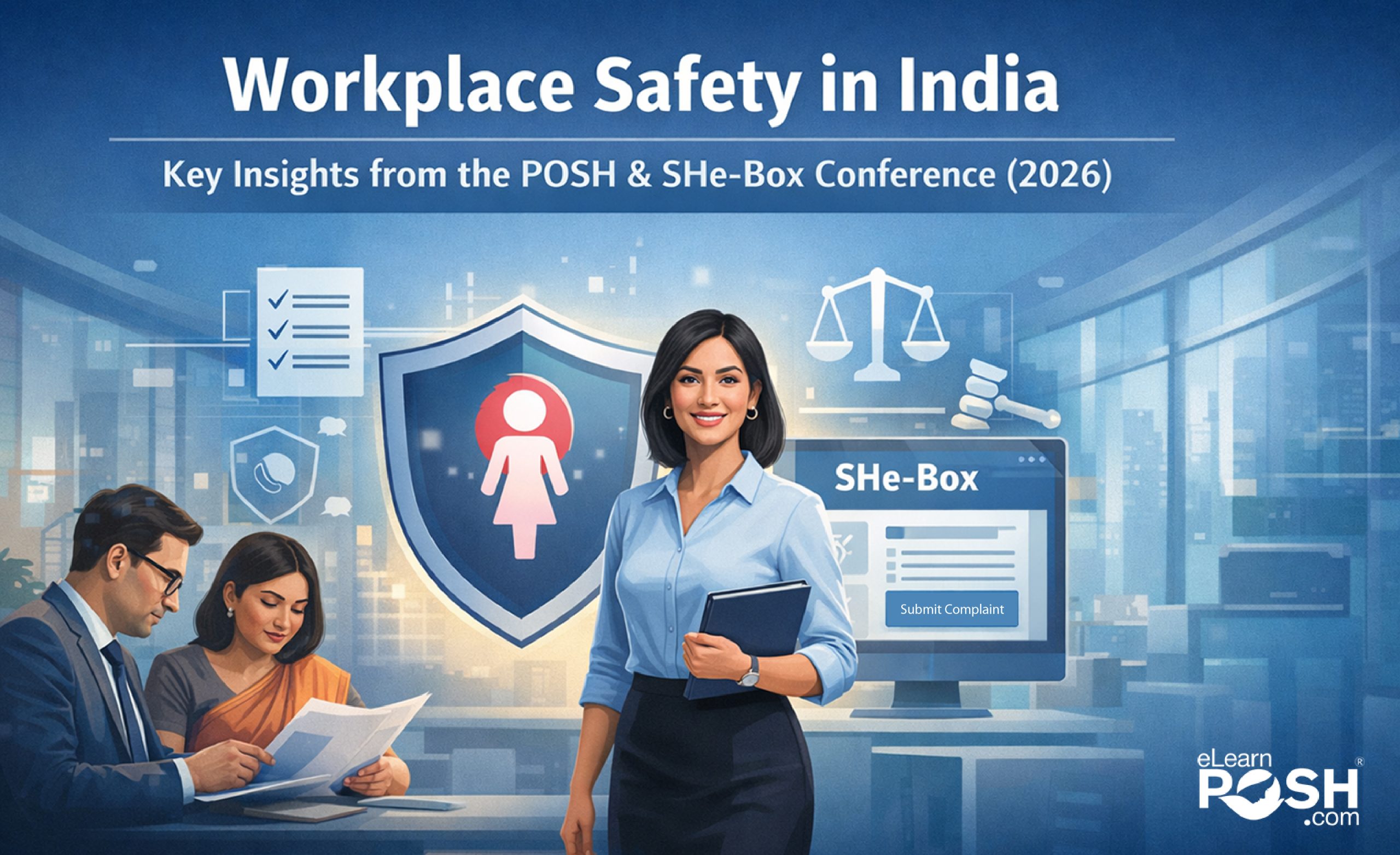
 The conference also reinforced the importance of the institutional structures that support the POSH framework.
 1. Formal branding of the SHe-Box platform
 The discussions at the conference placed workplace safety within a much broader context its direct impact on women’s participation in the workforce.
 Digital platforms like SHe-Box, stronger institutional frameworks, and increased emphasis on training are all shaping this shift.