


How Well Do We Know Our Own POSH Systems?
A Note to Our Readers
An employee may know that an Internal Committee exists and still be unsure how to approach it. A committee may be properly constituted yet need more preparation to handle a complaint fairly. This edition looks at those everyday concerns alongside recent legal and district developments. We revisit the Nashik case, examine what makes a POSH audit useful and explain a Delhi High Court decision on committee composition. You will also find a Thanjavur district update and a year-end reference for employers and IC members.
In this edition
- The Nashik case and access to help
- A practical guide to your POSH audit
- Delhi High Court on IC composition
- District Watch for Thanjavur employers
- POSH essentials for your year-end review
The Nashik Case and Access to Help
In April 2026, allegations involving employees at an IT company’s Nashik unit brought workplace sexual harassment into national discussion. Alongside the allegations came questions about reporting channels, access to the Internal Committee and what happens when employees are uncomfortable speaking up.
More than six months later, employers have a reason to revisit the workplace questions raised by the matter. Did the discussion lead to changes in reporting arrangements or manager training? If gaps were identified, has anyone checked whether they were addressed?
The Reported Developments
In its preliminary statement dated 17 April 2026, the company said its initial review had found no complaints of the alleged nature through its ethics or POSH channels. It also announced an internal investigation supported by external professional advisers, with oversight by a committee chaired by an independent director. This was an early company statement, not a final investigation finding.
At its May hearing, the National Commission for Women raised concerns about local grievance access, the absence of a dedicated Nashik IC, a joint committee for Pune and Nashik, and non-functional CCTV infrastructure. It directed corrective measures, including separate committees where required, POSH training and annual reporting.
Reporting dated 14 October 2026 stated that court hearings had begun in six of nine criminal cases. At this stage, the court was considering whether formal charges should be framed. This is a dated procedural update and does not establish guilt. The examination of workplace safeguards and POSH compliance must be distinguished from the courts’ determination of the criminal allegations.
 What an Empty Complaint Register Cannot Tell You
An organisation may find that no complaints have been reported. That information is relevant, but it leaves several questions unanswered. Do employees know whom to approach? Can someone contact the IC without involving their reporting manager? Would a contract worker or an employee at a smaller branch know the same route?
The answers may be reassuring. They may also reveal that a process which appears clear to HR is less clear to the people expected to use it. A policy stored in a folder that some workers cannot access does little to help them find the committee.
Start by checking where IC contact details appear. An outdated name or an unmonitored inbox can make the first step harder than it needs to be. Check who receives messages, who covers absences and whether employees can approach the committee directly.
Before the IC: Who Hears the Concern First
Employees do not always begin with a formal complaint. Someone may speak to a manager because they are unsure what happened, worried about the consequences or simply looking for guidance. The manager’s response can influence whether they seek further help.
A hurried reassurance that “we will speak to the person” may leave the employee uncertain about their options. Asking them to resolve the matter privately may create pressure they did not expect. Discussing the concern with colleagues can compromise confidentiality before a formal process begins.
Managers need enough preparation to listen without deciding the merits, explain the IC route and help the employee access it. Section 9 also requires the Presiding Officer or an IC member to provide reasonable assistance where the woman cannot put her complaint in writing. An employee should be able to seek help without understanding the entire legal process first.
Try this at your workplace: Ask a new joiner or contract worker to locate the correct IC contact without help. Then ask a manager how they would respond to an informal disclosure. Use any uncertainty to improve the reporting information and manager guidance. These are practical suggestions for employers, rather than findings about individual managers in the Nashik matter.
Read more: Company statement of 17 April | May NCW hearing | Court update of 14 October
Your Year-End POSH Review and Audit
A constitution order, training attendance sheet or filing acknowledgement tells you more than a tick beside “completed”. A useful POSH audit examines the records behind the answers and helps the organisation decide what needs attention.
People change roles, offices open or close, new employees join and local instructions are updated. The documents do not always keep pace. A committee formed some time ago may now have a vacancy. A training report may cover the main office while leaving out employees who joined later.
Put the Evidence Beside the Answer
“Yes, we have an IC” should lead to the current constitution order and a check of membership, tenure and office coverage. “Yes, training was conducted” should lead to dates, participation records and an understanding of who was covered. An employee awareness session and IC orientation serve different purposes.
Choose a person to coordinate the review and bring HR, the IC and the relevant office teams into it. The following records provide a useful starting point. Review only the complaint-related information needed for the exercise and restrict access appropriately.
 Understand the Checklist and the Audit Advisory
On 14 February 2026, the Ministry of Women and Child Development launched the PoSH Voluntary Compliance Checklist at its National Conference on Safety of Women at Workplace. It provides a reference for organisations reviewing their arrangements. The underlying statutory duties remain mandatory even though the checklist is voluntary.
Separately, the NCW’s advisory of 19 June 2026 recommended mandatory annual POSH audits for establishments employing ten or more persons, with reports to district authorities and concerned departments. Employers should check the state and district directions applicable to their workplaces, including any prescribed audit or submission process.
The voluntary checklist, the NCW advisory and local implementation requirements should be read separately. Completing an online self-assessment should not be assumed to satisfy every applicable audit or filing requirement.
What Our Self-Assessment Provides
Our free eLearnPOSH audit tool is aligned with key requirements under the POSH Act and the SHe-Box PoSH Voluntary Compliance Checklist. It provides a compliance score, question-wise status and a downloadable report based on the responses submitted. It helps draw attention to potential gaps; it does not independently verify records, provide compliance certification or generate detailed corrective recommendations.
After You Receive the Report
Review the responses marked “No” to identify areas requiring attention. As part of your internal review, also check that “Yes” responses are supported by current records. For each gap, agree on the action needed, who will take it and a completion date. Maintain confidentiality when reviewing any complaint-related records.
These follow-up steps belong to the organisation’s internal review. For example, a gap in IC membership needs an appropriate nomination and updated records; a gap in training coverage needs a plan for the people missed. Keep evidence of the action taken so the next review can check what changed.
One action to complete this week: Select one gap from the assessment, assign an owner and set a date to check that it has been resolved.
Start your free POSH self-assessment →
Read more: Government checklist launch | NCW advisory press release
Delhi High Court on IC Composition
A Delhi High Court decision of 27 October 2026 shows why employers should examine an Internal Committee’s eligibility and possible conflicts before an inquiry begins.
In Dr. XXXXXXXX & Anr. v. University of Delhi & Ors., the Court considered a challenge to a fresh IC constituted at a college. The Vice-Chancellor had set aside the earlier inquiry for two reasons. A committee member named in the events complained of had participated in the inquiry. The external-member requirement under the applicable UGC Regulations, 2015 had also not been duly followed. The complainants then objected to the replacement IC because the Principal had selected its members. They questioned her impartiality, partly because she had previously refused to allow the disputed member to withdraw from the earlier inquiry.
The High Court upheld the decision to require a fresh inquiry and rejected the challenge to the replacement IC. It noted that the principal was not a respondent to the complaint. The earlier committee’s members had been excluded, and the material presented did not establish a real likelihood of bias in the new committee.
These were separate issues. Defects in the earlier inquiry justified starting afresh; they did not automatically establish that the replacement IC was biased. The external-member issue arose within the UGC framework for higher educational institutions.
What Employers Can Take from the Decision
Before an inquiry proceeds, examine whether the members meet the applicable eligibility requirements and whether anyone has a relevant connection to the complaint, such as being named in the allegations, being a witness to the incident, or having a close personal relationship or financial interest that could affect their impartiality. Where an objection arises, assess the circumstances and record the reasons for the decision. A constitution order needs to be supported by a committee that can conduct the particular inquiry independently.
Read more: Read the judgment
District Watch for Thanjavur Employers
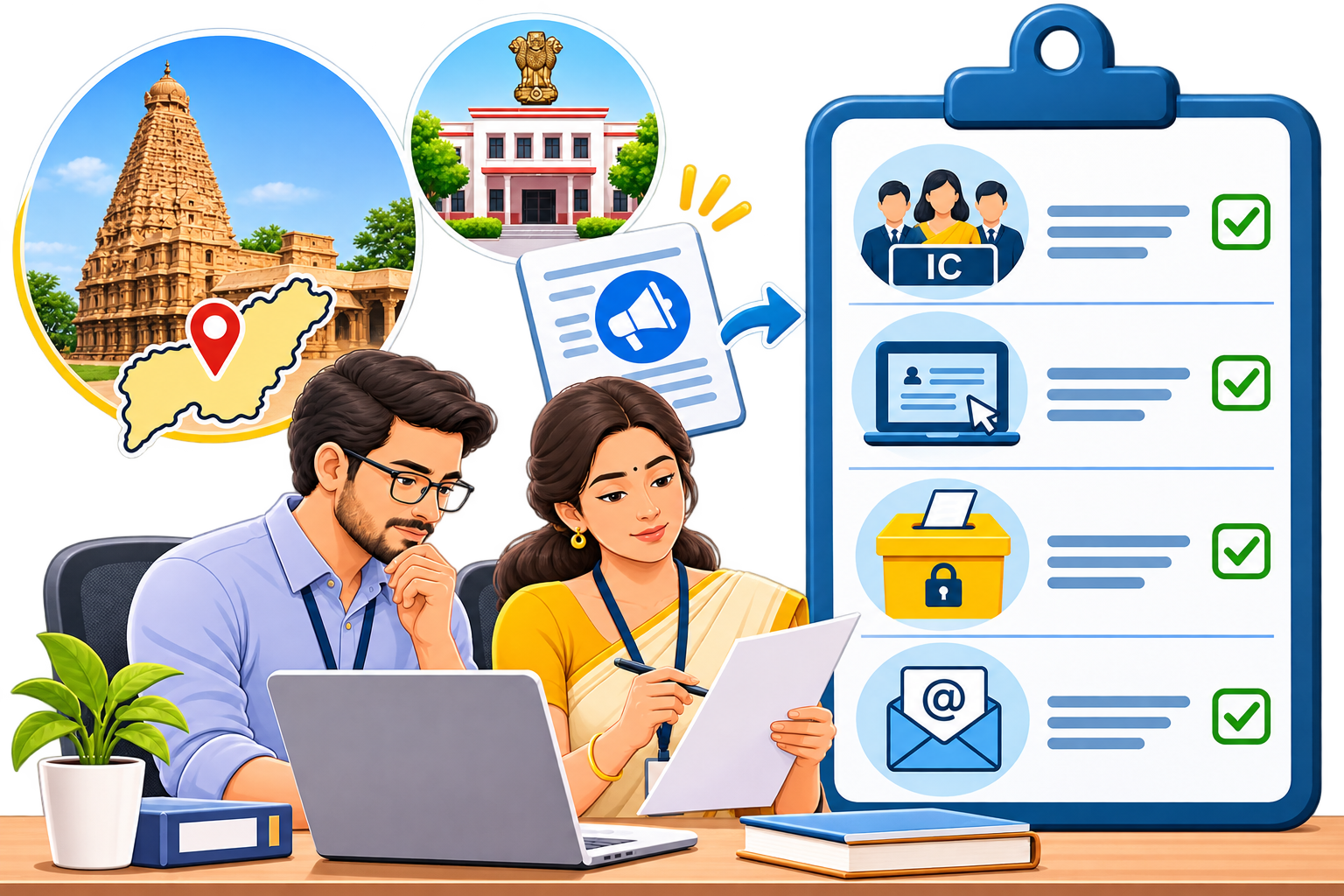
A communication issued by the Thanjavur district administration on 7 October 2026 calls on covered government and private workplaces to act on Internal Committee constitution, registration and complaint arrangements. Employers with workplaces in the district should check whether the instructions have been completed at each relevant location.
 What the District Has Asked Employers to Do
- Constitute the IC through a written order and check the required composition.
- Register the committee details on the Tamil Nadu IC portal identified in the notice. Keep the establishment details, current IC constitution order and members’ details ready when completing the registration. Retain a copy of the submission or acknowledgement for your records.
- Provide a complaint box as instructed in the district communication. To support its secure and confidential use, we recommend a clearly labelled, locked box in a location employees can access discreetly. Assign authorized IC representatives to check it regularly and ensure complaints reach the IC promptly and confidentially. Display the IC’s contact details nearby so employees can also approach the committee directly.
- Email details of the IC constitution and complaint-box arrangements to the District Social Welfare Office at dswo.tnj@gmail.com.
The complaint-box instruction is specific to this district communication. It should not be presented as a universal complaint-box requirement expressly imposed by the central POSH Act.
For your Thanjavur workplace: Ask the person responsible to compare the notice with the arrangements actually in place. Retain the current constitution order, registration record and evidence of the details submitted. Once a complaint box is installed, assign responsibility for checking it regularly and securely forwarding complaints to the IC.
Employers elsewhere should check their own district communications. Assign someone to monitor local instructions throughout the year, so a registration or information request is not discovered only when annual reporting begins.
Read more: District communication | Tamil Nadu IC registration portal
POSH Essentials for Your Year-End Review
As the 2026 calendar year draws to a close, employers and IC members can use this reference to organise outstanding compliance work. Start with the committee and reporting routes, then look at training, inquiry readiness and annual reporting. The checks below combine statutory responsibilities with practical follow-up.
Check the Committee and Reporting Routes
Workplaces with ten or more employees must constitute an IC through a written order. Check for a senior woman employee as Presiding Officer, at least two employee members and an eligible external member. At least half the members must be women, and the specified tenure of each member must not exceed three years. Section 4 provides alternative nomination arrangements where a senior woman employee is unavailable. Check coverage across offices and administrative units, as well as vacancies and expired nominations.
Employees should be able to find current contacts in the policy, workplace displays and internal communications. Someone joining midway through the year needs the same opportunity to understand the reporting process as a colleague who attended the annual session.
Keep the Local Committee route accessible too. Under Section 6, it receives complaints from establishments without an IC because they have fewer than ten workers, and complaints against the employer. Confirm the relevant district contact rather than directing every concern back to the internal reporting hierarchy.
Distinguish Awareness from IC Preparation
Section 19 requires awareness programmes at regular intervals and orientation for IC members. Employees need to recognise prohibited conduct and understand the available reporting and support arrangements. Committee members need preparation for receiving complaints, planning hearings, considering evidence and explaining their conclusions.
Review the people missed during the year, including new joiners and members nominated after the last IC session. A completion report for employee awareness does not, by itself, show that committee members have received the orientation needed for their role.
Keep Inquiry Responsibilities in View
When a complaint arrives, the IC needs practical support and a fair process. Section 11 governs the inquiry framework, including applicable service rules; Rule 7 is subject to that framework. The committee should plan proceedings so both parties have a meaningful opportunity to present their case and respond to relevant material.
- Complaint to the respondent: Rule 7 provides for sending a copy within seven working days of receipt by the committee.
- Respondent’s reply: The reply, document list and witness details are due within a period not exceeding ten working days from receipt of the complaint materials specified in Rule 7.
- Inquiry and report: The inquiry must be completed within 90 days. The IC’s findings report must be provided to the employer within ten days of completion and made available to the concerned parties.
- Action on recommendations: The employer must act on the recommendations within 60 days of receipt.
Where both parties are employees, Section 11 requires them to be heard and given the findings so that they can make representations before the committee. The IC should allow for this step before finalising its report and track deadlines alongside the fairness requirements.
The employer should ensure access to relevant information and facilities needed for the IC’s work. Protect complaint and inquiry information in accordance with Section 16, including through controlled access to files and careful communication.
 Prepare for Annual Reporting
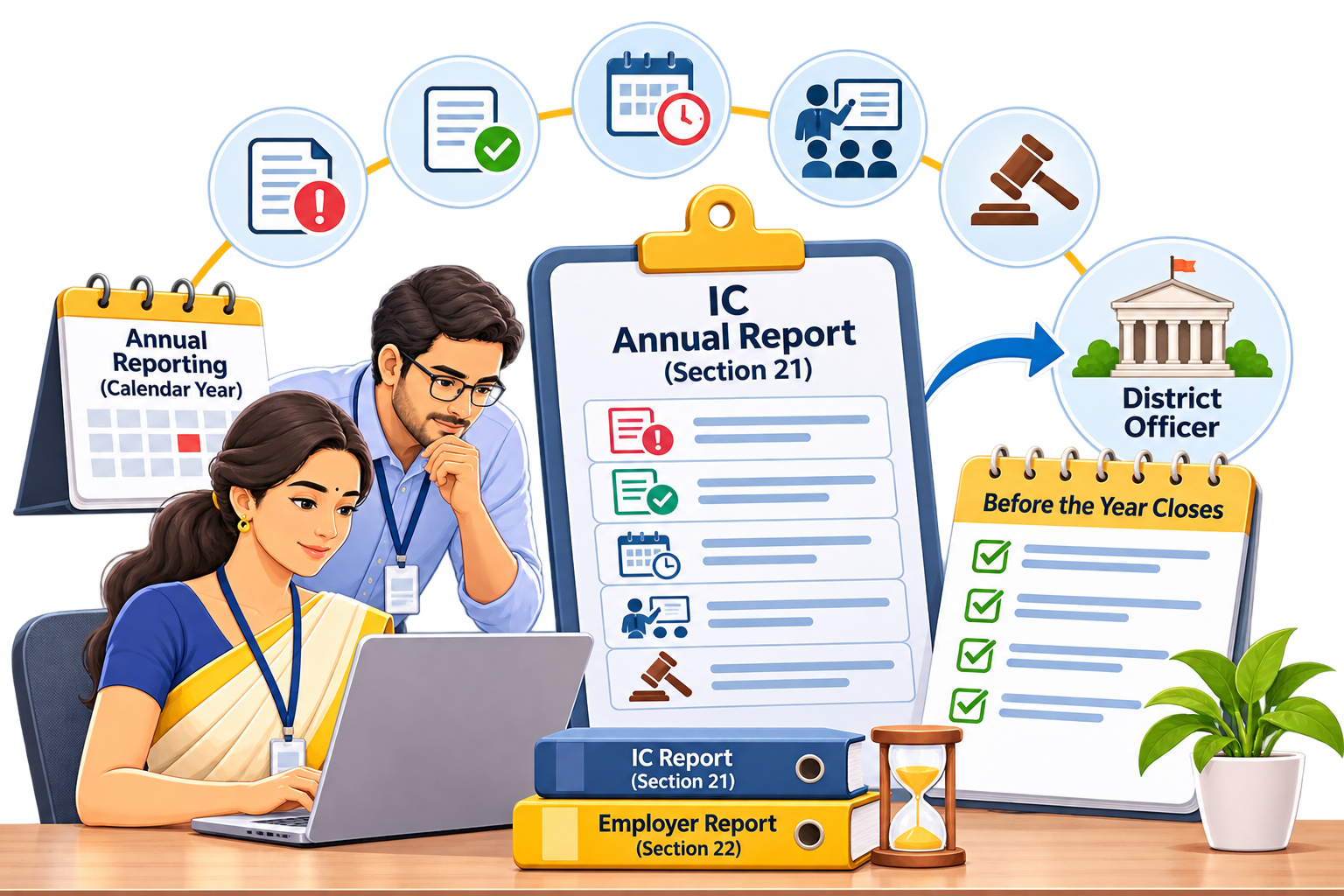
Section 21 requires the IC’s calendar-year annual report to be submitted to the employer and District Officer. Bring together the Rule 14 information: complaints received and disposed of, cases pending beyond 90 days, workshops or awareness programmes conducted, and the nature of action taken. Prepare the records now and reconcile the full-year position after 31 December.
The employer’s Section 22 responsibility is separate. It requires complaint numbers and disposal information in the organisation’s annual report, or intimation of case numbers to the District Officer where no such organisational annual report is required. Assign responsibility for this alongside the IC report.
Check applicable district formats, submission routes, portal instructions and deadlines. Keep acknowledgements with the relevant report so the organisation can establish what was submitted and when.
Before the Year Closes
- Confirm the current IC membership, tenure and contact details for each relevant workplace.
- Identify training and orientation gaps and arrange the necessary follow-up.
- Check progress and deadlines for any pending inquiry or recommendations.
- Bring annual reporting data together and confirm who will prepare and submit each required report.
- List outstanding corrections with an owner and target date, then schedule a review.
Read more: POSH Act | POSH Rules including Rules 7 and 14