


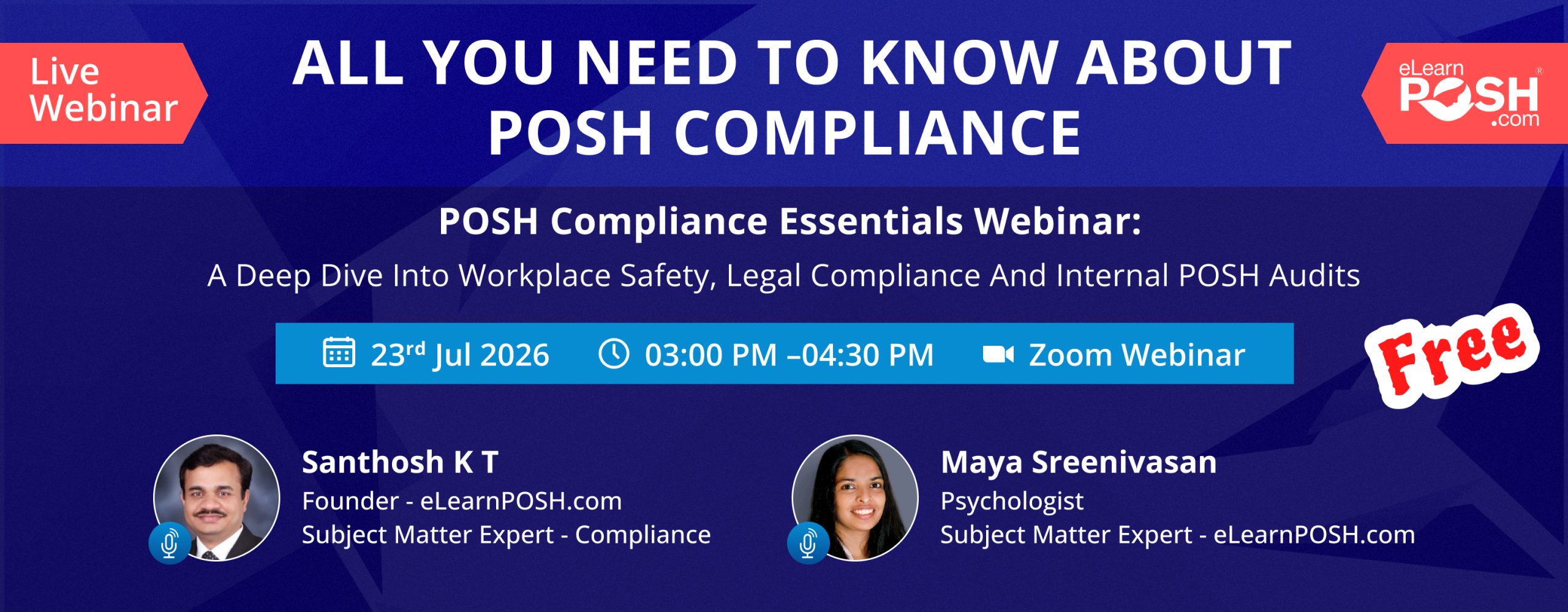
All You Need to Know About POSH Compliance
A Deep Dive into Workplace Safety, Legal Compliance and Internal POSH Audits
Date & Time:
23rd July 2026
|
3:00 PM
to
4:30 PM IST
In today’s evolving professional landscape, ensuring a safe and respectful workplace is not just a legal requirement, but a cornerstone of organizational integrity, employee welfare and responsible governance. The Sexual Harassment of Women at Workplace (Prevention, Prohibition and Redressal) Act, 2013, commonly referred to as the POSH Act, provides the legal framework for preventing and addressing workplace sexual harassment in India.
This webinar is designed to provide a practical and detailed understanding of POSH compliance and the responsibilities it creates for organizations. The session will help participants understand the key steps required to build a safer workplace where employees feel respected, protected and empowered to report concerns.
We will also discuss the recent advisory issued by the National Commission for Women, which emphasizes stronger POSH implementation, regular awareness initiatives, professional training for Internal Committee members, SHe-Box usage, annual reporting, workplace safety mechanisms and annual POSH audits for establishments employing ten or more persons.
Throughout this session, we will explore the seven key steps to ensure POSH compliance.
Live on Zoom
Steps to Ensure POSH Compliance
Drafting a POSH Policy
The POSH policy is the foundation of compliance. It should explain the law, define sexual harassment, identify covered persons, describe complaint channels, clarify inquiry timelines and state the organization’s zero-tolerance approach.
Key aspects covered:
- Define sexual harassment with examples.
- Cover employees, interns, consultants, trainees, contractors and third-party situations.
- Explain complaint filing, inquiry, confidentiality, interim relief and possible outcomes.
- Include anti-retaliation safeguards.
Constituting an Internal Committee
Every workplace with 10 or more employees must have an Internal Committee. The IC is responsible for receiving complaints, conducting inquiries, making recommendations and supporting a fair redressal process.
Key aspects covered:
- Woman Presiding Officer.
- At least 50% women members.
- External member with relevant expertise.
- IC constitution for each eligible office, branch or unit.
Creating Awareness for Employees
Employees must know what sexual harassment means, how to report it, who the IC members are and what protection the law provides. Awareness should be ongoing and should not be limited to onboarding.
Key aspects covered:
- Conducting regular awareness sessions.
- Displaying IC details and complaint procedures.
- Using posters, emails, intranet pages and town halls.
- Including managers, interns, contractors and trainees in awareness initiatives.
Capacity Building for IC Members
IC members need specialized training because they perform a sensitive and quasi-judicial role. They must understand legal procedure, fairness, confidentiality, sensitivity, documentation, evidence and report writing.
Key aspects covered:
- Training IC members on inquiry procedure.
- Covering principles of natural justice and confidentiality.
- Building skills for trauma-sensitive complaint handling.
- Training on findings, recommendations and closure reports.
Annual Report Filing
Organizations must maintain annual POSH data and submit statutory reports. Annual reporting demonstrates that the employer is tracking complaints, awareness activities and compliance obligations.
Key aspects covered:
- Number of complaints received.
- Number of complaints disposed of.
- Number of cases pending beyond prescribed timelines.
- Workshops and awareness programmes conducted.
- Action taken by the employer.
SHe-Box Registration and Readiness
SHe-Box is a digital platform for workplace sexual harassment complaints. Organizations should be prepared to update relevant details and inform employees that SHe-Box is an additional complaint and tracking mechanism.
Key aspects covered:
- Maintaining updated organization details.
- Keeping IC information ready.
- Informing employees about the platform.
- Tracking and responding to any complaint routed through SHe-Box.
Internal POSH Audit and Compliance Review
In light of the recent advisory issued by the National Commission for Women, organizations are now expected to move beyond basic POSH documentation and demonstrate active compliance.
The advisory recommends annual POSH audits for establishments employing ten or more persons and emphasizes regular awareness, IC training, annual reporting, transparency, SHe-Box usage and workplace safety mechanisms.
As part of this session, we will explain how an Internal POSH Audit can serve as the 7th step in a complete POSH compliance framework. The audit helps organizations verify whether their POSH policy, IC constitution, employee awareness, IC training, complaint handling, reporting, SHe-Box readiness and workplace safety practices are actually working in practice.
Who Should Attend?
This webinar is suitable for:
- Internal Committee members
- HR professionals
- Legal professionals
- Compliance specialists
- Business leaders
- Founders and management teams
- Anyone interested in building a safer and more respectful workplace
This webinar is not just a journey through the legal requirements of the POSH Act. It is also a practical platform to discuss compliance best practices, implementation challenges, internal audit readiness and workplace safety culture.
Join us as we navigate the key requirements of the POSH Act and empower organizations to foster a workplace environment that is safe, respectful and conducive to professional growth.
We will also answer questions from participants about the POSH Act, compliance requirements and practical implementation.
Speakers

Santhosh KT
Founder, eLearnPOSH.com | Subject Matter Expert – Compliance

Maya Sreenivasan
Psychologist | Subject Matter Expert – eLearnPOSH.com