
1. The Shift from POSH Compliance to Real Workplace Effectiveness
2. How SHe-Box Is Changing Workplace Harassment Reporting in India
3. Understanding Internal Committees and Local Committees Under POSH
4. New Government Initiatives: POSH Compliance Checklist, SHe-Box Integration & Training Platforms
5. Why POSH Training and Awareness Are Now Critical for Organisations
6. The Link Between Workplace Safety and Women’s Workforce Participation
7. Why Collaboration Is Key to Strengthening Workplace Safety Systems
8. What Organisations Should Do Next: Key Action Points from the Webinar
9. Final Takeaways: What This Means for Workplace Safety in 2026
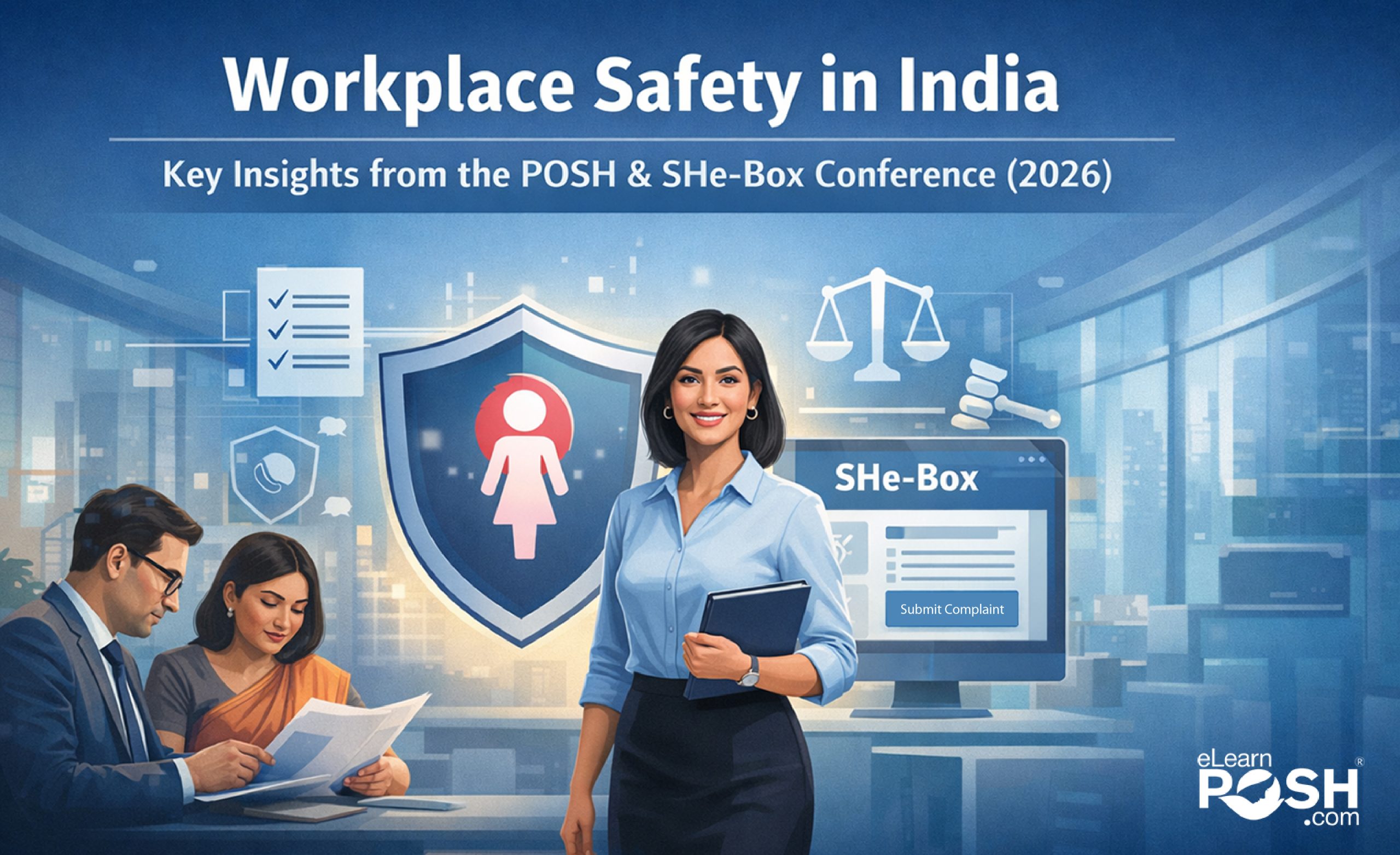
If you missed the National Conference on Workplace Safety held on 14 February 2026 at Vigyan Bhawan, here’s everything you need to know without having to sift through multiple sources.
Organised by the Ministry of Women and Child Development, the conference brought together policymakers, industry leaders, and compliance professionals to discuss how workplace safety laws, particularly under the POSH Act, are evolving in practice. The full conference can be viewed through this link National Conference on Safety of Women at Workplace | Webcast Services of National Informatics Centre, Government of India
But this wasn’t just another policy discussion.
What stood out was a clear shift in thinking from simply having systems in place to evaluating whether those systems actually work when it matters most.
Click here to access the official video from the Ministry’s YouTube channel: National Conference on Safety of Women at Workplace (SHe-Box)
1. The Shift from POSH Compliance to Real Workplace Effectiveness
 For years, organisations have focused on meeting the formal requirements of the POSH Act – drafting policies, setting up Internal Committees (ICs), and conducting awareness sessions.
On paper, most workplaces today appear compliant.
However, the discussions at the conference made it clear that compliance alone is no longer enough. The real focus has now moved to how effectively these mechanisms function in practice.
When a complaint is raised:
- Is the process easy to access?
- Are employees confident enough to report?
- Is the inquiry handled fairly and consistently?
These are the key questions organisations must be well equipped to address when managing employee complaints.
Many participants acknowledged that while structures exist, the strength of implementation varies widely. This gap between formal compliance and actual effectiveness is where organisations are now being increasingly expected to improve
2. How SHe-Box Is Changing Workplace Harassment Reporting in India
One of the most talked-about aspects of the conference was the growing role of the SHe-Box portal.
 SHe-Box is a government-backed digital platform that allows women to file workplace sexual harassment complaints online. Once submitted, complaints are forwarded to the relevant Internal Committee or Local Committee and can be tracked through the process.
This introduces a significant shift.
Traditionally, complaint handling has remained internal to organisations. But SHe-Box adds a layer of transparency and accessibility that reduces dependency on internal reporting channels alone.
For employees, this means:
- Easier access to reporting
- Greater confidence in escalation
- Visibility into complaint progress
For organisations, it means increased accountability. Complaint handling is no longer entirely internal; there is now an external system that can track and monitor progress.
The growing adoption of SHe-Box reflects a broader move towards digitised and transparent compliance mechanisms.
3. Understanding Internal Committees and Local Committees Under POSH
 The conference also reinforced the importance of the institutional structures that support the POSH framework.
Under the law:
- Organisations with 10 or more employees must constitute Internal Committees (ICs)
- Local Committees (LCs) operate at the district level for smaller establishments or informal workplaces
Over the years, the expansion of these committees has significantly improved accessibility to complaint resolution systems. More individuals today have formal channels to raise concerns than ever before.
However, their effectiveness still depends heavily on how well they are trained and how consistently procedures are followed.
4. New Government Initiatives: POSH Compliance Checklist, SHe-Box Integration & Training Platforms
The conference also shed light on a few important government initiatives that aim to make workplace safety systems more visible, accessible, and effective in practice.
 1. Formal branding of the SHe-Box platform
One of the key developments is the formal branding of the SHe-Box platform. While SHe-Box has been in existence as an online complaint mechanism, the introduction of official branding gives it a stronger identity and presence. This move is significant because it helps position SHe-Box as a trusted, centralised platform for reporting workplace sexual harassment. For employees especially those in smaller organisations or unorganised sectors this visibility can make a real difference in encouraging reporting.
2. voluntary POSH compliance checklist
Another notable initiative is the voluntary POSH compliance checklist, which is intended to serve as a practical self-assessment tool for organisations to evaluate how effectively they are implementing POSH requirements. While the official checklist has not yet been made publicly available, regions such as Delhi and Gurugram have already been using their own versions of compliance checklists. These can offer useful reference points for organisations looking to assess their systems. Both regions have historically taken the lead in strengthening POSH compliance, and it is likely that the checklist to be issued by the Ministry will follow a similar structure and approach.
- Link for compliance Checklist for Gurugram – CamScanner 12-23-2025 12.32.21
- Link for compliance Checklist for New Delhi District – PoSH Act Compliance Checklist (Comprehensive) | District New Delhi, Government of NCT of Delhi | India
3. SHe-Box with the Mission Shakti mobile application
The integration of SHe-Box with the Mission Shakti mobile application further strengthens accessibility. By bringing the complaint mechanism onto a mobile platform that is already designed around women’s safety and support, the government is making it easier for individuals to access help when needed. This integration also connects workplace grievance redressal with a broader ecosystem of support services, creating a more seamless and user-friendly experience.
This app is accessible on both Android and iOS, Through this app users can access a range of services including helpline, legal support, and workplace grievane redresaal via SHe-Box. This means that employees are not limited to internal mechanisms alone but they also have the option to raise complaints through an external, government- backed platform.
It is further important to note that this initative is an add on to the existing complaint mechanism to ensure that POSH related grievances are seriously handled, and this does not replace internal POSH processes or the role of IC. For organisations, the focus is not on adopting the app, but on being prepared for its implications. Complaints filed through SHe-Box may be routed to the employer for action, making it essential for internal systems to be responsive, timely, and aligned with legal expectations.
4. Karmayogi Bharat (iGOT)
The availability of POSH training modules through the Karmayogi Bharat (iGOT) platform is another significant step towards strengthening implementation. These modules are hosted on the government’s iGOT Karmayogi portal, a digital learning platform designed for capacity building through self-paced, online courses. POSH-related modules are available on the platform and provide structured guidance on roles, responsibilities, and procedures, particularly for stakeholders such as Internal Committee members and HR professionals.
The courses are typically modular and self-paced, allowing users to complete them at their convenience, although the exact duration and access details may vary. While many of these modules appear to be accessible upon registration, the platform follows a mixed model, and availability may differ across courses.
In terms of usage, these modules can serve as a valuable learning resource for organisations looking to standardise understanding and build internal capability. However, they should be viewed as supplementary rather than a replacement for organisation-led POSH training. The law still expects employers to conduct workplace-specific awareness sessions and ensure that Internal Committees are adequately trained in the context of their own organisational environment.
Overall, these initiatives reflect a broader intent to move beyond formal compliance and build systems that are more visible, accessible, and effective for employees in real-world situations. Together, these steps indicate a move towards standardisation and continuous improvement in workplace safety practices.
5. Why POSH Training and Awareness Are Now Critical for Organisations
A recurring theme throughout the conference was the importance of training especially for Internal Committee members.
ICs are responsible for:
- Conducting inquiries
- Evaluating evidence
- Ensuring adherence to principles of natural justice
These responsibilities require more than basic awareness.
Without proper training, even well-designed systems can fail in practice. Inconsistent handling of complaints, procedural errors, or lack of sensitivity can undermine trust in the entire process.
At the same time, employee awareness is equally important.
Employees need to understand:
- How to file a complaint
- What the process involves
- What standards of behaviour are expected
When both the committee and employees are well-informed, the system becomes more reliable and credible.
6. The Link Between Workplace Safety and Women’s Workforce Participation
 The discussions at the conference placed workplace safety within a much broader context its direct impact on women’s participation in the workforce.
In her keynote address, Union Minister Annapurna Devi emphasised that workplace safety is not just a legal requirement, but a reflection of the country’s commitment to equality and justice. This perspective was reinforced by data shared during the conference, which highlighted a significant rise in women’s labour force participation from around 23% to over 40% in recent years.
As more women enter the workforce, the need for effective safety mechanisms becomes structural rather than optional. Speakers also pointed out that a large proportion of women continue to work in the informal sector, where access to grievance redressal remains limited—making the role of accessible and trustworthy systems even more critical.
Within this context, workplace safety was framed not just as a compliance requirement, but as an enabler of economic participation. Transparent complaint mechanisms, fair processes, and clear accountability help build trust and that trust plays a crucial role in enabling women to enter, remain, and grow in professional environments.
In this sense, strengthening POSH implementation contributes not only to compliance, but to broader goals of inclusion, equity, and economic growth.
7. Why Collaboration Is Key to Strengthening Workplace Safety Systems
Another key takeaway from the conference was the importance of collaboration across stakeholders.
The event brought together representatives from government institutions, private sector organisations, civil society groups, and international bodies. More importantly, these interactions moved beyond high-level discussions and focused on practical challenges in implementation.
Several recurring themes emerged from these exchanges. For instance, many organisations acknowledged that while Internal Committees are formally constituted, their effectiveness varies significantly often due to lack of training, inconsistent processes, or limited understanding of legal requirements. This highlighted the need for capacity-building and standardised training, which initiatives like the Karmayogi platform aim to address.
Another common challenge discussed was low reporting of complaints, not necessarily due to absence of issues, but because of lack of trust in the process, fear of retaliation, or limited awareness of available mechanisms. This is where tools like SHe-Box and its wider integration were seen as important in improving accessibility and confidence.
Participants also pointed out gaps in implementation within the informal sector and smaller organisations, where POSH structures are either weak or non-existent. This reinforced the importance of centralised platforms and government-led interventions to bridge these gaps.
At the same time, organisations shared practices that have worked well such as regular, scenario-based training, clear communication of processes, and visible leadership commitment to workplace safety all of which contribute to building trust among employees.
These discussions made it clear that while there is no one-size-fits-all solution, organisations are facing similar challenges. Learning from these shared experiences allows them to refine their own systems in a more informed and practical way.
As workplace safety frameworks continue to evolve, such collaboration plays a crucial role in ensuring that systems are not only compliant, but also relevant, responsive, and effective in real-world situations.
8. What Organisations Should Do Next: Key Action Points from the Webinar from the Webinar
For organisations that could not attend the webinar, the insights translate into a set of practical next steps. The focus is not just on what needs to be done, but how organisations can begin strengthening their systems.
1. Review how your POSH framework works in practice
Instead of only checking whether policies exist, organisations should conduct a mock walkthrough of the complaint process. For example, ask:
- If an employee raises a complaint today, what steps will follow?
- How easy is it to access the process?
- Are timelines clearly defined and followed?
This helps identify gaps between documented procedures and actual execution.
2. Assess the preparedness of Internal Committee members
Simply constituting an IC is not enough. Organisations should:
- Conduct periodic training sessions focused on real case scenarios
- Ensure members understand principles of natural justice, confidentiality, and documentation
- Evaluate whether IC members feel confident handling complex or sensitive cases
Where gaps exist, external training or standardised modules (such as those on Karmayogi Bharat) can be useful.
3. Strengthen employee awareness and confidence
Awareness is not just about sharing policies once a year. Organisations can:
Use multiple channels induction sessions, internal platforms, posters, and emails
Clearly explain how to report, whom to approach, and what to expect after reporting
Reinforce non-retaliation policies to build trust
The goal is to ensure employees feel safe using the system, not just knowing it exists.
4. Explore alignment with SHe-Box
Organisations should familiarise themselves with how SHe-Box works and:
- Inform employees that it exists as an external reporting option
- Align internal processes to ensure timely response if a complaint is escalated through SHe-Box
- Treat it as a mechanism that enhances transparency and accountability
5. Use the voluntary compliance checklist as a periodic audit tool
Once available, the checklist can be used to:
- Conduct quarterly or bi-annual internal audits
- Track gaps in areas like IC functioning, training, documentation, and timelines
- Create action plans based on identified gaps, rather than treating it as a one-time exercise
9. Final Takeaways: What This Means for Workplace Safety in 2026
The conference made one thing clear workplace safety in India is entering a more mature phase. The focus is no longer on whether organisations have policies in place, but on whether those policies translate into fair, transparent, and effective systems.
 Digital platforms like SHe-Box, stronger institutional frameworks, and increased emphasis on training are all shaping this shift.
For organisations, this brings both a challenge and an opportunity.
The challenge lies in moving beyond surface-level compliance. Organisations must now ensure that their systems can withstand real situations handling complaints with consistency, maintaining confidentiality, building trust among employees, and ensuring Internal Committees are truly equipped to manage cases. This requires time, investment, and a shift in mindset from reactive compliance to proactive accountability.
At the same time, it presents an opportunity to build systems that are not only compliant but also credible. Organisations that invest in effective processes, transparent communication, and employee trust will be better positioned to create safe and inclusive workplaces.
Because ultimately, workplace safety is not just about meeting legal requirements it’s about creating environments where people feel safe, heard, and respected.
And that is what truly defines an effective system.

Leave a Reply