

The Protection of Sexual Harassment (POSH) Act, 2013
Establishing the legal framework for the prevention, prohibition, and redressal of sexual harassment at the workplace, including educational institutions.

eLearnPOSH
Best training on POSH
At your institution, we prioritize creating a safe and respectful environment for all members. Our comprehensive e-learning course on gender sensitization and sexual harassment prevention is designed to equip staff and students with crucial knowledge and skills to foster a culture of respect and equality.

Promote a Safe Environment: Understand the importance of gender sensitization and its role in preventing sexual harassment.
This course is aligned with key legal and regulatory frameworks aimed at ensuring a safe and respectful environment in higher educational institutions:
Establishing the legal framework for the prevention, prohibition, and redressal of sexual harassment at the workplace, including educational institutions.
Mandating institutions to establish committees for the prevention, prohibition, and redressal of sexual harassment.
Requiring institutions to set up mechanisms for addressing sexual harassment complaints and promoting a safe campus environment.
Educational Excellence: Enhance institutional reputation and credibility by demonstrating commitment to social responsibility and ethical practices.
Designed for campus-wide awareness, stronger compliance, and a safer learning environment.
The UGC Regulations, 2015, and the AICTE Regulations, 2016, mandate that educational institutions establish proper mechanisms for the prevention, prohibition, and redressal of sexual harassment. Our course not only meets but exceeds these guidelines, ensuring compliance and promoting a positive learning and working environment for all.
Join us in fostering an environment where everyone feels respected and valued. Enroll today and make a difference in creating a safer and more inclusive community at your organization.
Schedule a DemoExplore key answers on campus POSH compliance, student and staff awareness, Internal Committee duties, and reporting to complete HEI POSH training with more clarity and confidence.
Sexual harassment in educational institutions refers to any unwelcome or inappropriate behaviour of a sexual nature that creates an uncomfortable environment for students, faculty, or staff. It can affect a person's emotional well-being, academic performance, and overall sense of safety on campus.
Common examples include making inappropriate comments, passing sexual jokes, sending unwanted messages, sharing explicit images or videos, staring in a disturbing way, touching without consent, or asking for sexual favours. These actions can occur in person, online, or through any form of communication.
Sexual harassment is broadly classified into four types: verbal (spoken words), written (messages or emails), visual (images or gestures), and physical (touch or proximity). Each type can occur independently or together, creating an unsafe environment.
Verbal sexual harassment includes inappropriate comments, sexually explicit jokes, repeated unwanted proposals, or pressuring someone to engage in sexual activity. Even casual remarks can be considered harassment if they make someone uncomfortable.
Written sexual harassment involves sending offensive emails, texts, or social media messages, making inappropriate comments about someone's body or personal life, or sharing explicit content digitally. This also includes cyber harassment and sexting without consent.
Physical sexual harassment includes any unwanted physical contact such as touching, hugging, pinching, brushing against someone intentionally, or invading personal space in a way that makes the person uncomfortable.
Quid pro quo harassment occurs when someone in a position of authority (like a professor or supervisor) offers academic or professional benefits such as grades, recommendations, or promotions, in exchange for sexual favours. It involves misuse of power.
A hostile environment is created when repeated or serious inappropriate behaviour makes a person feel unsafe, intimidated, or unable to perform academically or professionally. This could include repeated jokes, gestures, or offensive content.
Anyone associated with the institution, including students, teaching and non-teaching staff, interns, volunteers, visitors, or applicants can file a complaint if they experience or witness harassment.
Sexual harassment complaints should be reported to the Internal Complaints Committee (ICC), which is the official body responsible for handling such cases within the institution.
The ICC is a legally mandated committee formed to prevent, investigate, and resolve sexual harassment complaints. It ensures that complaints are handled fairly, confidentially, and without bias.
A complaint should ideally be filed within three months from the date of the incident or from the last occurrence in case of repeated incidents. Extensions may be considered in special circumstances.
You can start by clearly objecting to the behaviour if you feel safe. Document the incident, save any evidence, and report the matter to the ICC. Seeking support from trusted individuals is also helpful.
Yes, it is not mandatory to confront the harasser. You can directly approach the ICC if you feel unsafe, uncomfortable, or fear retaliation.
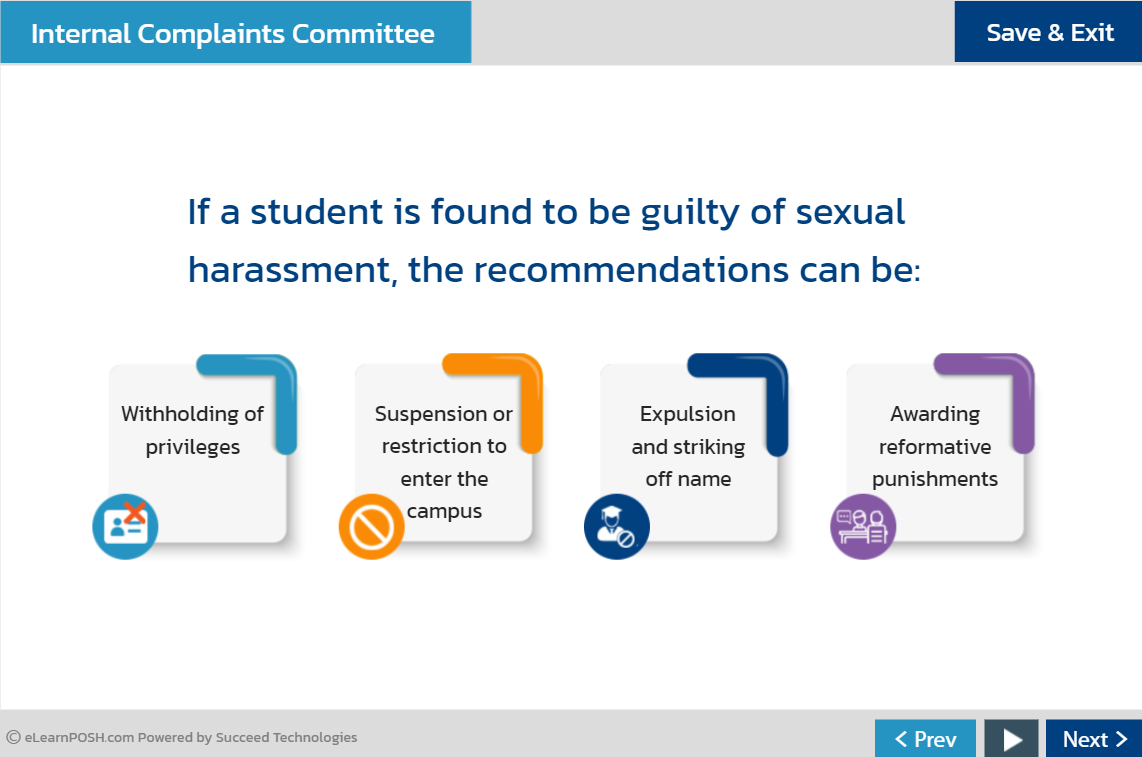
Depending on the severity, actions may include warnings, suspension, expulsion (for students), or termination (for employees). Other disciplinary measures may also be applied.
In harassment cases, the impact of the behaviour matters more than the intent. Even if the person did not intend harm, the behaviour is considered harassment if it causes discomfort or harm to the victim.
This standard evaluates whether a reasonable person in the same situation would find the behaviour offensive or inappropriate, helping determine if the act qualifies as harassment.
Retaliation refers to any negative action taken against someone for reporting harassment or participating in an investigation, such as demotion, bullying, or unfair treatment.
General disagreements, workplace conflicts, or feedback without any sexual nature are not considered sexual harassment, although they may violate other institutional policies.
If a complaint is proven to be intentionally false or malicious, disciplinary action may be taken. However, lack of evidence alone does not mean the complaint is false.
Prevention involves maintaining respectful behaviour, understanding boundaries, speaking up against inappropriate conduct, and supporting a culture of safety and inclusion.
If you witness harassment, support the affected person, discourage the behaviour if safe, and report the incident to the ICC or appropriate authority.
Yes, the policy applies to all institution-related activities, including internships, field trips, events, transportation, and off-campus programs.
Yes, you can file a complaint with the police at any time, and the ICC can assist you in the process if needed.
This course helps you understand what constitutes harassment, how to identify it, and how to respond appropriately. It empowers you to contribute to a safer and more respectful environment.
It improves awareness, encourages respectful behaviour, reduces conflicts, enhances safety, and ensures compliance with legal requirements.
It equips individuals with knowledge about their rights, responsibilities, reporting procedures, and ways to prevent and address harassment effectively.
Yes, under the POSH Act and UGC regulations, institutions are required to provide awareness and training to ensure a safe environment.
By educating individuals about acceptable behaviour and encouraging accountability, the course helps build a respectful and harassment-free campus culture.
Yes, it demonstrates professionalism, ethical awareness, and understanding of workplace conduct, which are valued in any career.
Anyone associated with an institution including students, faculty, employees, interns, and volunteers should take this course.
Training should be conducted regularly, preferably annually, to keep awareness updated and reinforce safe practices.
You will learn about types of harassment, reporting mechanisms, legal rights, responsibilities, prevention strategies, and how to handle real-life situations.
Yes, it significantly reduces incidents, improves reporting, builds trust, and creates a safer, more inclusive environment for everyone.
Explore specialized learning paths for employees, managers, Internal Committee members, POSH complaint management, POCSO child safety training, and unconscious bias awareness.
 POSH Courses
POSH awareness training to help employees understand the law, recognize inappropriate behaviour, and contribute to a safer, more respectful workplace.
Know More POSH Courses
Equip people managers to handle complaints fairly, work with the Internal Committee, and take proactive measures against workplace sexual harassment.
Know More POSH Courses
Structured IC training and compliance tools so committee members handle complaints with confidence, sensitivity, and accuracy-not just check-the-box workshops.
Know More Complaints Management System
A secure, paperless POSH complaint management platform to file complaints, manage cases, track evidence, and ensure timely resolution.
Know More POSH Courses
Introduces staff and students to POCSO law and child protection policy, clarifying duties and responsibilities to ensure a safe learning environment.
Know More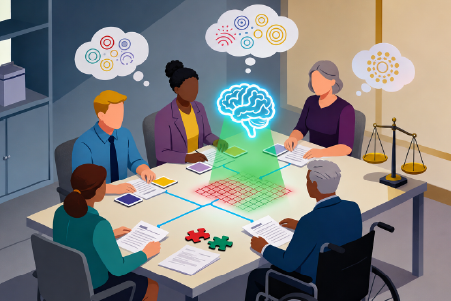 Global Courses
Helps employees recognize hidden biases that influence hiring, teamwork, and decisions, with practical strategies for a more inclusive workplace.
Know More