


The “She Was Friendly” Fallacy: Why Warmth Is Not Consent
Introduction: The Dangerous Misreading of Ordinary Warmth The Core Mistake: Confusing Social Access With Sexual Consent What the POSH Law Actually Looks…

eLearnPOSH
Best training on POSH
1. HEI Regulations, 2015 (UGC): Does this law apply to you?
2. HEI Regulations vs POSH Act: Key Differences and Legal Overlap
3. Who Can File Sexual Harassment Complaints Under HEI Regulations?
4. How HEI Regulations, POSH Act, UGC and AICTE Frameworks Work Together
5. What is the role of managers and leaders you may ask?
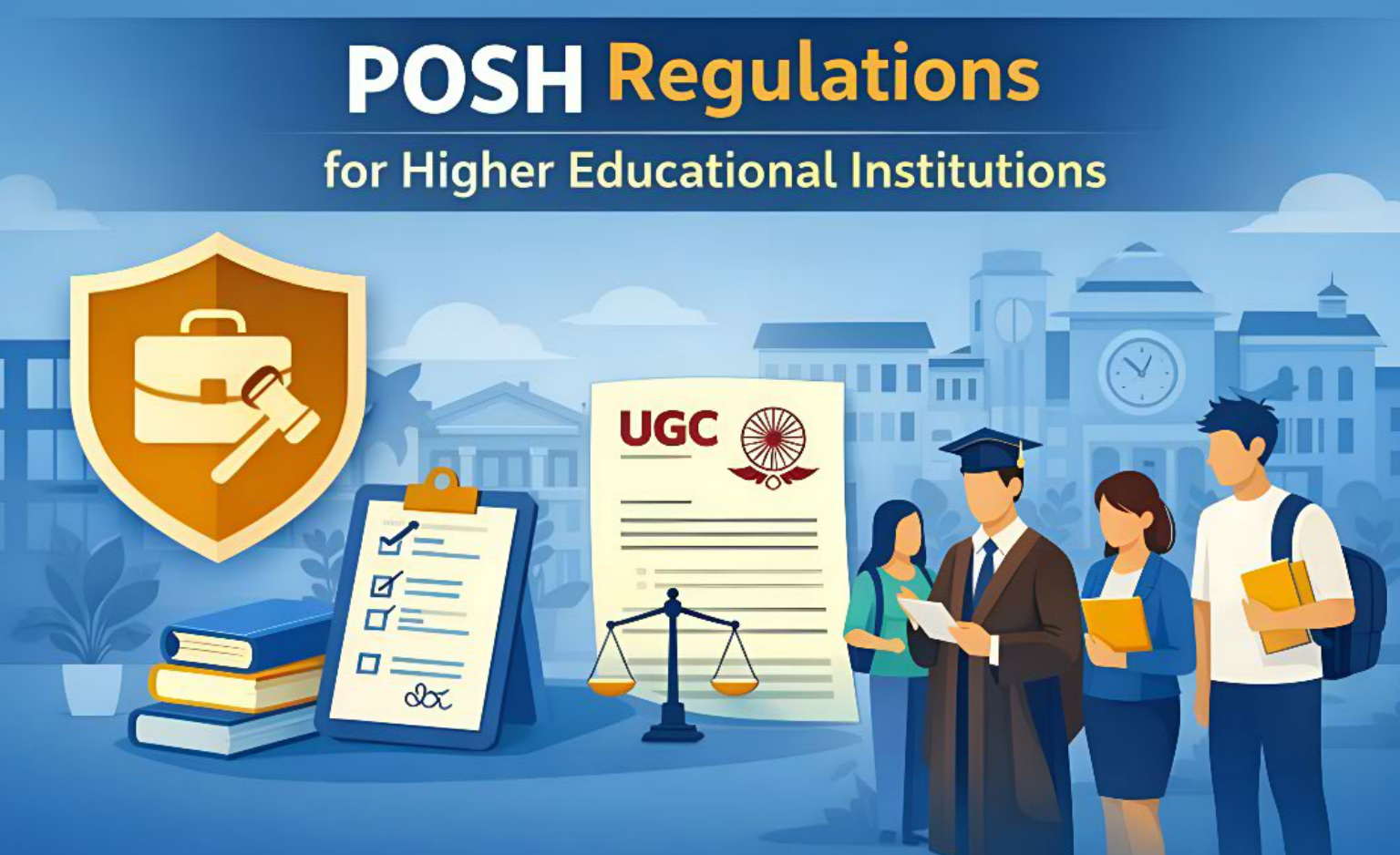
If you work in a university, college, or higher educational institution, this law applies to you. More specifically, if you are a principal, vice-chancellor, director, dean, head of department, administrator, or part of HR or management, the HEI Regulations place direct responsibility on you, not just on a committee.
The HEI Regulations [University Grants Commission (Prevention, prohibition and Redressal of sexual harassment of women employees and students in higher educational institutions)] Regulation, 2015. work hand in hand with the POSH Act, particularly drawing from the broad definition of sexual harassment under Section 3 of the POSH Act. While POSH was enacted to address sexual harassment in workplaces, it soon became clear that educational institutions needed special attention. Colleges and universities are not just places of learning they are also workplaces, residential spaces, and environments where students lived.
Under POSH, the concept of a “workplace” is deliberately broad whereas in HEIs, this extends to any space or activity connected to the institution whether physical or virtual making off-campus incidents, online interactions, and academic travel equally relevant.
| BASIS | POSH | POCSO | HEI |
|---|---|---|---|
| Who is Protected? | Applicable only for women | Any child below 18 Years of age. (Gender Neutral) | Students and women employees |
| Gender | Women centric | Gender Neutral – applies to boys and girls | Gender neutral for students, women centric for employees |
| Nature | Civil Law | Criminal Law | Civil Law |
| Application | Workplace and workplace related duties | Everywhere | Campus, hostels and academic linked activities |
| Purpose | Prevent and address sexual harassment of women at workplace | Protect children from sexual abuse | Ensure campus safety and institutional accountability |
| Burden of Proof | Burden is on complainant to establish their case (Preponderance of probabilities – Civil Case) | Burden is on the accused to prove his innocence (Reverse Onus) | Burden on complainant (Preponderance of probabilities – Civil) |
| Filing of Complaint | Victim/ If victim cannot then third party can file | Anyone can file for complaint | Victim or third party if victim is unable |
| Complaint Redressal | Inquiry by Internal Committee (IC) (As per service rules) (IC) | Report to Police FIR Action by Court | Inquiry by Internal Committee (UGC norms) |
| Limitation | Within 3 months from the date of event (extendable by another 3 months) | No limitation | Within 3 months of incident |
| Consequences | Disciplinary action, termination, compensation | Imprisonment (can extend to life) and/or fine | Suspension, rustication, termination |
| Explore our Courses | POCSO | POSH for HEI |
To understand how POSH law and POCSO apply to Higher Educational Institutions, and how this compares with HEI-specific requirements under UGC Regulations, click Know more
To know more about the applicability of POSH law and POCSO in comparison with BNS (Bharatiya Nyaya Sanhita) section 75, click Know more
For example; A student depends on a professor for grades, recommendations, and academic progress; a researcher depends on a guide; a staff member depends on senior administrators. The law recognises that such power dynamics can make individuals especially women more vulnerable to harassment and less likely to speak up.
That is why HEI Regulations recognise that complaints can be raised not just by employees, but also by women students, researchers, interns, and even visiting professionals associated with the institution.
The aim of the HEI Regulations is therefore clear: to ensure that women employees and women students are safe, heard, and protected, without fear of academic, professional, or personal retaliation. These regulations expand the workplace concept under POSH to fit the realities of educational institutions. As a result, protection is not limited to classrooms alone but extends to hostels, laboratories, libraries, fieldwork locations, conferences, internships, sports events, study tours, and any activity connected to the institution, whether on or off campus.

Alongside the HEI Regulations, it is also important to understand who regulates which institutions and why sexual harassment compliance cannot be avoided by falling outside one framework. In India, universities and colleges that are UGC-affiliated are governed by the UGC Regulations on sexual harassment, which are designed specifically for higher education spaces. These regulations strengthen POSH implementation on campuses by mandating Internal Committees, awareness programmes, reporting obligations, and leadership accountability. For UGC institutions, POSH compliance is not optional or symbolicit is a regulatory expectation tied to institutional governance and credibility.
Along with the HEI Regulations and POSH framework, institutions today are also expected to align with the broader spirit of the Saksham recommendations introduced by the UGC. Saksham is not just about rules on paper it focuses on building campuses where safety and dignity are built into everyday systems. It encourages institutions to go beyond complaint redressal and look at prevention through awareness, infrastructure safety, counselling support, and strong gender-sensitisation initiatives.
In simple terms, Saksham pushes institutions to ask a deeper question: Are we only reacting to problems, or are we actively creating safer campuses? It emphasises visible reporting mechanisms, accessible support systems, trained committees, and continuous sensitisation so that students and employees feel confident speaking up. When read together with HEI Regulations and POSH, Saksham strengthens the message that safety is not a one-time compliance exercise it is an ongoing institutional responsibility.
On the other hand, technical and professional institutions such as engineering colleges, polytechnics, and management institutes that fall under AICTE approval are guided by separate AICTE regulations on gender sensitisation and prevention of sexual harassment. These guidelines echo the principles of the POSH Act but adapt them to technical education settings, covering both employees and students. Here again, institutions are expected to actively prevent harassment, create accessible complaint mechanisms, and build a culture of safety through training and sensitisation.
Now comes a question that many institutions quietly ask: What if we are neither UGC-affiliated nor AICTE-approved? The answer is simple and unequivocal the POSH Act still applies. The POSH law is a central legislation that covers all workplaces in India, including private educational institutions, training centres, coaching institutes, research organisations, and standalone colleges. Regulatory silence does not mean legal immunity. Even without UGC or AICTE oversight, the obligation to constitute an Internal Committee, conduct fair inquiries, and protect women from sexual harassment remains fully enforceable.
Think of UGC and AICTE frameworks as sector-specific lenses built on top of the POSH Act. They customise compliance for universities and technical institutions, but they do not replace the law itself. POSH remains the foundation, and every educational institution regardless of size, affiliation, or regulator stands on it.
For example, a private skill-training institute that is not affiliated with UGC or approved by AICTE may assume it sits outside formal regulation. But if it employs staff and engages with students, it is still a “workplace” under POSH. Any incident of sexual harassment there must be addressed through a duly constituted Internal Committee, following the same principles of fairness, confidentiality, and accountability as any university or engineering college.
In essence, there is no regulatory gap when it comes to sexual harassment law. Whether through UGC regulations, AICTE guidelines, or the POSH Act directly, every educational institution carries a clear legal responsibility to prevent harassment, respond to complaints, and protect the dignity and safety of women. Ignoring this is not just a compliance failure it is a leadership failure with serious legal and reputational consequences.
There is also a common misunderstanding that HEI Regulations apply only when a student is involved. In reality, the regulations are designed for the entire higher education ecosystem. They cover women students, but they also extend to women employees including faculty, administrative staff, researchers, interns, and others working within the institution.
This means that if a situation arises between two professors, two staff members, or between employees at any level within a university or college, it does not automatically fall outside the HEI framework. In many cases, HEI Regulations and the POSH Act operate together. POSH remains the main workplace law across India, while HEI Regulations provide additional structure tailored specifically to academic environments, where power dynamics and institutional relationships can be complex.
Put simply, HEI Regulations are about the institutional environment, not just the identity of the people involved. If the incident is connected to the higher education institution and falls within its ecosystem, the HEI framework may still be relevant, alongside POSH obligations.
In essence, HEI Regulations reinforce the spirit of the POSH Act by adapting it to the unique ecosystem of education. Together, they place a clear responsibility on institutional leadership to prevent harassment, respond promptly to complaints, and create an environment where dignity, safety, and equality are non-negotiable.
a. A legally compliant and trained Internal Committee
b. Clear reporting channels for students and staff
c. Timely, confidential, and unbiased inquiries
d. Regular awareness and sensitisation programs
Failure to do this is not just a policy lapse but it can attract regulatory action by the UGC, reputational damage, and accountability for the institution’s leadership. Simply put, under the HEI Regulations, campus safety is a leadership responsibility, not a committee formality.
Introduction: The Dangerous Misreading of Ordinary Warmth The Core Mistake: Confusing Social Access With Sexual Consent What the POSH Law Actually Looks…

1. Why synthetic sexual content belongs in the POSH conversation 2. Weather workplace have moved beyond office premises? How does this affects…
1. What Triggered the Karnataka POSH Crackdown? 2. The Legal Position Was Always Clear 3. The Gap Between Compliance and Functioning…

1. The Shift from POSH Compliance to Real Workplace Effectiveness 2. How SHe-Box Is Changing Workplace Harassment Reporting in India 3. Understanding…
Leave a Reply